Shanah Tovah, everyone! I hope that this year, we will not continue the stupid mistakes of last year, and that the unfortunate events of last year will not repeat themselves.
Speaking of repetition, I spent (another) day at the Louvre this weekend. This weekend was the Day of Italian Paintings: that's virtually all I saw, but my itinerary took me from the medieval painters of the Sienese school to the canvases of the age of Louis XIV.
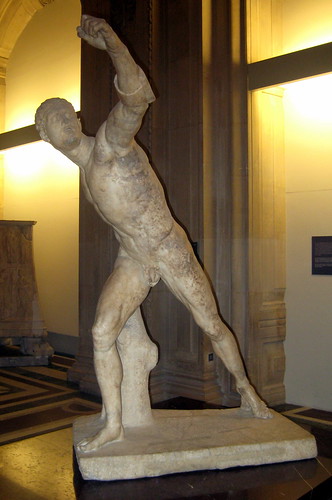
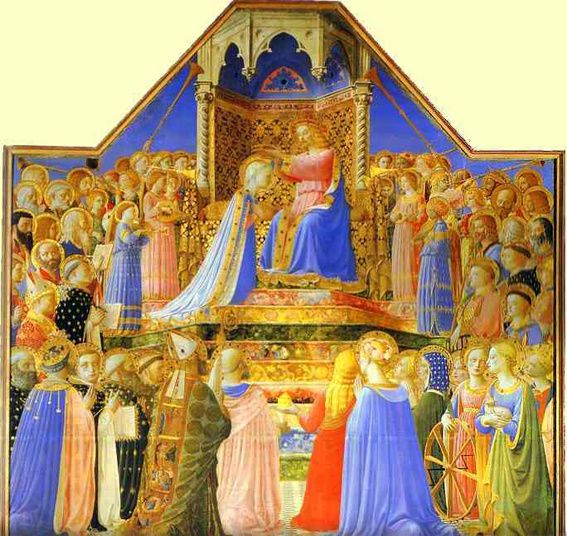
The curators of the Louvre have worked hard to present their Italian paintings in a historically coherent fashion, that nonetheless is free from strict chronology. They have converted a colossal second-floor hallway in the Denon wing, perhaps the longest continuous wing in the entire palace, into a gallery to display their great Italian treasures. I would guess that at least 20% of the paintings depicted the Madonna and child, even though by the middle of the seventeenth century, this motif is no longer in vogue. The earliest Italian paintings, those dating from the late 13th century, were in a side room, as was the Mona Lisa, but for the most part, the chronological trajectory was straight. Oh, and I also passed two famous Greek statues, dating from antiquity, on the way, "The Gladiator" (who actually isn't a gladiator), and the "Victory of Samothrace."
The first room contained some well-known names to those of you familiar with art history, or just with Dante's Divine Comedy. Cimabue and Giotto, two great painters of the 14th century, who, like all their contemporaries, painted only religious scenes. Whereas Cimabue's style places him squarely in the medieval school, on account of his highly impersonal representations of saints and angels outside of time and space, however well he executed them, Giotto began to innovate, and began to situate his paintings in time, at precise moments in history. Today, it seems obvious that a painting, even a still-life or a portrait, is in some sense a snapshot of a particular object at a particular time, but in the middle ages, Mary and Jesus, surrounded by angels, stare out at the spectator in a kind of calm eternity. They are objects of veneration. However, Giotto welcomes his viewers to imagine a specific moment in time. His paintings changed not only the history of art, but also the history of religion; according to Van Loon's Arts, Giotto's wonderful paintings of the life of Saint Francis of Assisi are what brought about such enormous popularity to this sect (indeed, the Franciscans are still around today, and I have a friend who is considering joining them, although he seems to be leaning closer to the Dominicans). I saw one of these paintings, and it was quite fantastic, capturing the moment in which Saint Francis received the stigmata (I also saw a very obvious imitation of it by a painter of the Sienese school, who lacked the creativity to compose his own tableau). In the same room, of a slightly later period, were two 15th-century monk-painters, Fra Angelico and Fra Filippo Lippi, who were lucky enough to be painting after Brunelleschi invented linear perspective, and also lucky enough to be patronized by the Medici. While Fra Angelico had an enormous love of bright color, Lippi played with light and shadow, and made great strides (to my eyes) in increasing the level of realism in painting, even going so far as to situate a self-portrait rather prominently in one painting. For those of you who don't know, Lippi was a great womanizer, and Cosimo de Medici often had to be patient with the monks debaucheries.
Yes, and so the Renaissance was beginning. The Louvre has several paintings by such illustrious artists as Titian, Raphael, and Leonardo da Vinci. Yes, I saw the Mona Lisa, although I wasn't paying as strict attention to it as the mob of tourists waiting in line to come within several meters of the painting. It turns out that the woman in the painting is actually a historical figure, and that the French title of the painting, "La Joconde," is actually a pun on her surname; the painting might have been intended as a wedding present, even though Francois I brought it home in his luggage after his wars in Italy. Facing the Mona Lisa is Veronese's huge, huge painting, "The Wedding of Cana," the largest painting in the Louvre; I have absolutely no idea how they even managed to transport it to its current location: they must have unrolled it, and constructed the frame inside of the gallery, and then hung the painting on a nail the size of a parking meter. The massive painting was commissioned by a Dominican monastery, who hung it in their dining hall. However, the Dominican order forbids speaking during mealtimes, so the lively painting, full of action and music (the musicians may have been modeled after musicians whom Veronese knew personally) ended up accompanying many a dour, silent meal. In the same gallery is hidden a fairly good painting entitled "Concert champetre," or "meadow concert;" the painting depicts a singer and a lute-player just about to begin playing, accompanied by two nudes. The composition is actually a clever allegory of poetry, and the inner and the meanings hidden between the lines, as represented by the two naked women. Not far from these is a colorful painting of Paradise that once hung over the throne of the doge, in Venice. The last painter not to miss in this room is a less-known Bassan, who decided to include depictions of daily life in his work, which was at the time an unusual choice. In a painting of what is ostensibly Hephaestus's forge, the artist visited a local smithy, and has meticulously portrayed the artisans at work; in another painting, Bassan took the same approach towards viticulture and wine-production.
There are a number of other interesting 16th-century paintings in the gallery. There is a series of four portraits, called the Four Seasons, by Arcimboldo, and presented to Maximilien II of the Holy Roman Empire in 1573. The painting, four portraits cleverly composed of various vegetable and floral arrangements, are actually symbolic palimpsests, simultaneously presenting the four seasons, the four humors, and the unity of an Empire that was a variegated hodgepodge of various nationalities, language-groups, and religions. There are some excellent religious paintings dating from the early Counter-Reformation, and particularly good are those painted by a fellow named Carrache, who also took the trouble to paint countryside scenes of fishing and hunting, towards the late 16th and early 17th centuries. One of the most unusual paintings of this section, however, is a large painting situated in the middle of the corridor, depicting the same scene from two different angles, one on one canvas, and another on a canvas on the opposite side. The scene is that of David about to decapitate Goliath with the latter's sword; from one side, one sees the faces of the two, and from the other, the backs; the painter's name is Danielle de Volterra.
In the Louvre's exhibit on Italian painting, between the 16th and the 17th centuries are two markers. The first is a large white urn, placed in the center in the hallway; the second is the series of works by Caravaggio (such as this one), who recreated painting. Developing (though not inventing) the method of clair-obscur, this painter completely changed the way painters depicted light, just as da Vinci had a century or so earlier. If you love the light of Vermeer, and the darkness of Rembrandt (as I do), you will know what I mean. Although I still prefer the work of the two Dutchmen to that of the Italian, it is only because the former have a special place in my heart. However, Caravaggio did more than transform style, he also made a drastic change in subject; although "humanist" is an overused and imprecise term, I believe that it characterizes his general elision of angels from his paintings. There are certainly exceptions to this (such as the painting of the Akedah), but when angels appear, they seem human, obeying the same laws of light and shadow as human subjects; likewise, even when halos appear, they are faint circles.
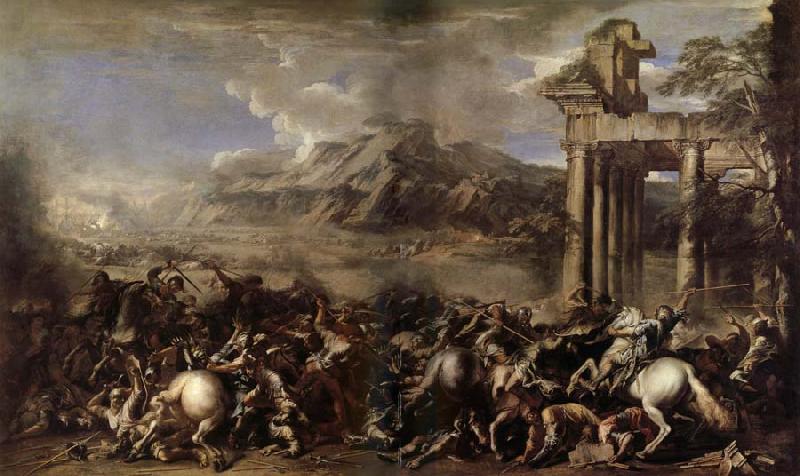
After Caravaggio, there are few remarkable paintings. Painters who I had not heard of, whom I will probably forget, such as Le Guerchin, Revi, Le Dominiquin, and Salvatore Rosa, dominated. This last painter has an interesting story, however. When he was young, he spent time with a group of bandits, and many of his paintings include violent themes. His most famous, "Bataille heroique," painted 1652, is intriguing, because it is anything but heroic; it is violence, pure and simple. The painting followed a series of extremely violent civil wars in France (which I have been reading about), and this painter decided to paint a battle without heroes, fought in a smoking, deserted landscape. Needless to say, Louis XIV wasn't too excited about it, and nobody paid much attention to it for a few centuries. Now, according to the Louvre curators, it is without a doubt his most famous painting.
That night, I went out with some Cornellians, and didn't get back until 4 am. It was a long day!
~JD
"Aucun d'eux ne pensait qu'un roi eleve dans l'eloignement des affaires osat prendre sur lui le fardeau de gouvernement. Mazarin avait prolonge l'enfance de ce monarque autant qu'il l'avait pu" [Not one of them thought that a king raised at a distance from the affairs of state would dare to take upon himself the burden of governing; Mazarin had prolonged the childhood of this monarch as much as he could] (Voltaire, Le Siecle de Louis XIV, p. 229).
Showing posts with label da Vinci. Show all posts
Showing posts with label da Vinci. Show all posts
Sunday, October 2, 2011





Monday, September 26, 2011
Chateaux II: Return to the Loire!
Back to the Loire Valley, but this time, with EDUCO! The rendez-vous was at 7:45 in the 6th arrondissement, so I got up around 6:00, and trotted off to catch the bus. I slept through most of the bus ride out; at noon, we arrived in the village of Amboise, home of both the royal chateau of the same name, and Clos Luce (Da Vinci's house, if you remember that entry). We had until 1:30 to stroll through the town and eat lunch. I had made a sandwich the night before, which I ate as a checked out the ramparts of Amboise, even managing to take a picture of its funny-shaped exterior, from below. Still during lunch hour, I took a stroll to Clos Luce's Da Vinci Park, taking the opportunity to examine several of the gadgets, and listen to several parts of the Leonardo-guided tour, that I hadn't before. Particularly interesting was an explanation of his study of the "human machinery," and of his recognition of the similarities between a cow's stomach and our own, and a frog's nervous system, and our own; at one time, he had ten cadavers, which he had dissected.
I met back with the rest of the EDUCO students (and had a bit of a discussion with our guide about Gothic Flamboyant architecture), and we all visited Clos Luce as a group. I hadn't noticed it the first time around, but there is a secret underground passageway leading from the chateau of Amboise to Clos Luce (it's closed to visitors), which Francois I used to furtively visit da Vinci. I also hadn't noticed that Marguerite de Navarre had her own bedroom at Clos Luce, for her visits to her brother's hired genius.
Most people don't know about Marguerite de Navarre (aka Marguerite d'Angouleme), and I think that it's only fair that I introduce this exceptional woman. Queen of Navarre, and older sister of Francois I of France, Marguerite was a highly-social, highly-astute woman, best remembered today for her great work of literature, the Heptameron (modeled on Boccaccio's Decameron), a collection of seventy "framed" stories. However, she was a true Renaissance woman, and seemed to be everywhere, meeting everyone there is to meet in the Renaissance (her friendship and fascination with da Vinci is a perfect example of this). Apparently a quick thinker, she wrote while traveling in her carriage. A purveyor of tolerance, she offered shelter to the much-persecuted Protestants. Her statue now stands in the Jardin Luxembourg, and you can see my photo of it on Facebook.
After trotting around the Parc da Vinci, where I played the tour guide for a few of my friends, we hopped back on the bus, and traveled to one of my favorite chateaux -- Chenonceau, the queens' chateau with the two magnificent gardens. Again, I noticed a few things I hadn't before, such as the massive mother-of-pearl cabinet offered as a wedding present to Henri II and Catherine de Medicis by the Republic of Venice, and the Flemish tapestry illustrating this happy event. Our guide seemed to recognize my general interest for all of the history surrounding us, and happily chatted with my friend Ade and me about the furniture, paintings, architecture, and tapestries. As I've mentioned before, there is absolutely nothing like visiting a chateau with a historian, nothing like it at all.
Next stop was wine-tasting at Pere Auguste, a family-owned winery that produces Touraine wine. The business is fairly small, and it was one of the owners who gave us a tour of the presses and fermenting tanks. I nearly had a moment of confusion, due to the identical pronunciation of the words for "rooster" (coq) and "grapeskin" (coque). There were fruitflies in the winery, which was a bit unnerving, but the wine was quite good. There were four qualities -- white, red, rose, and sparkling -- and I'll admit that I preferred the Rose, but wasn't too wild about the red. The wine cost 15 Euros for three bottles, which is a very good deal in France, and the winery made quite a good revenue that day from the American tourists!
Back on the road, we arrived at the countryside hotel where we were to spend the night. We had rented out an entire building, where we were three-to-a-room. There were only five male students who had come on the trip, however, so Nick and I jumped to grab a double together (there are a few more boys who didn't show up, but yes, EDUCO is almost all girls, and every current staff member is female). After about 10-15 minutes just to put our things away, and find out in which room the cute girls were staying, we headed over to the dinner room, where we had a far, far better meal than I think anyone had expected. The sole vegetarian got an omelet and courgettes to go with his fusilli, but it was a good omelet. After dinner, our guide led us in some French drinking songs, "Les Chevaliers de la Table Ronde," and "Buvons un coup, buvons en deux."
Soon after dinner, the party started. I hadn't realized it, but many of my classmates had purchased wine in order to consume it that night, together. I couldn't contribute much, but my friends were more than happy to share. We had a pretty good time, sitting together in the middle of a field, and playing various games designed to divulge our sexual lives. I managed to teach Dead Monkey to the rest, which went over surprisingly well. I had a very good time, and didn't get trashed.
Next morning, up at seven. Not fun, after a night like that! Still, Nick and I stumbled over to the breakfast room, beating the rest of the bleary-eyed crowd. Before long, we hopped back on the bus, headed for Blois.
I'd like to retract every negative statement I made about the royal chateau of Blois in my last entry on the town (published about six weeks ago). Although I maintain that the town feels like a tourist trap, and that the Maison de la Magie just across the way is a cheesy swindle, the only fault I have with Blois is that photography is forbidden, and my only quarrel with our tour of the chateau is that it was too quick. The chateau is absolutely fantastic, architecturally, because there are four distinct historical building periods discernible to the naked eye, even to me. Standing in the central courtyard, one look at the red-brick 15th-century Italian-style Gothic flamboyant wing constructed under Louis XII, turn ninety degrees to see the amazing 16th-century Renaissance wing ordered by Francois I, and turn another ninety degrees to see the unfinished 17th-century Classical wing ordered by Gaston, duc d'Orleans. When Gaston was in the midst of construction, his brother, Louis XIII, had a son; suddenly, Gaston was no longer heir to the throne of France. His allowance being cut off in such an abrupt fashion, he lacked the funds to complete his architectural plans, let alone demolish the older sections of the castle, as he had planned. For this reason, the conglomeration exists as it does today. Blois has been fabulously and meticulously restored with paintings, tapestries, and furniture, almost as well as Langeais. The castle is the site of a famous murder, that of Henri II's brother, who during the wars of religion was supported by the ultra-catholic faction; with the support of the first estate and a large section of the third, he was likely to become king. Henri disposed of him, summoning him to his (Henri's) presence, where he (the duc) would be without his customary bodyguard. Months later, in a fabulous boomerang effect, Henri II was himself assassinated. This event was followed by the War of the Three Henris (I'm not kidding about this), leaving, finally, Henri IV, founder of the Bourbon dynasty, and author of the Edict of Nantes, as king, in the last decade of the 16th century. Naturally, Henri IV was assassinated only a few years afterward... You can also see the secret cabinets, concealed in the wall, where Catherine de Medicis hid important documents of state, etc. (no, not poison).
Next up was another castle I had not visited, the Chateau de Beauregard. To be honest, it's nothing more than a hunting lodge, owned by Henri II's secretary of state. The building itself is not terribly interesting, historically, nor particularly beautiful; the grounds are abundant, but none too interesting. The floor and walls of the upstairs gallery, however, are the real treasure trove of the chateau. The floor is finely decorated with delft porcelain tiles, depicting a 16th-century army on the march, each row of tiles depicting a soldier bearing different arms. The walls, meanwhile, are covered with dozens of portraits, depicting the principal actors in French politics, reign-by-reign, from the time of the Hundred Years' War until the time of Louis XIV, the sun king. Our guide gave us a rapid explanation, explaining who was who. Many of the historical personages were not even French; Francois I was situated beside Suleiman the Magnificent, and Charles V of the Holy Roman Empire.
Following the tour was one of the most sumptuous and gourmet meals I believe I have ever had, and certainly the nicest I have had in the last few year. We sat in the Orangerie, and enjoyed plate after plate of fine French food -- couscous, tomato, quiche, salad, wine, cheese, good bread, decent red wine, strawberries in wine, etc. There was good company too (I sat with some very cool people, including all four of the other male students on the trip), and though several unforeseen events did occur, they served more as conversational topics than as anything capable of ruining a meal. The first was the fat spider I spotted floating in my wine, after I had taken no more than a couple of sips. The second was the fact that, unlike at the hotel where we stayed the night, the Orangerie had not prepared a vegetarian meal in advance for me, so they just threw together an omelet (surprise, surprise), but at least they didn't complain. When David found a lock of hair in his salad, we assumed that it was meant for me, who had had the temerity to mention the spider.
The waitress had kindly brought our whole table a new jug of wine after the arachnid incident, and so I drank a little bit more than I should have; I still felt a buzz when we arrived at Chambord, the great pleasure-house of Francois I. The chateau is so vast that in my two visits, I still haven't seen everything, but I did notice a few points of interested that I had missed on my first round. The first was the office, complete with furniture, where Louis XIV had dictated the repeal of the Edict of Nantes (he signed it at Fountainbleu). I had also missed the beds of Louis and of the king of Poland, and one of the three titanic ceramic stoves installed by the Marechal of Saxe (all three men were proprietors, at one time or another). I also visited the rooms dedicated to the Compte de Chambord, so-called Henri V, reading about the man on whose shoulders so much royalist hope rested, the "miracle child" born after the assassination of his father.
We sadly had very little time to visit the chateaux, but the trip was amazing. I dozed for part of the bus ride back to Paris, and also played Contact with the other students. Now I'm back, class has begun at La Sorbonne, and I'm (finally) making some French friends. Hope all is well with you.
~JD
"Enfin le regime egalitaire -- qui serait l'acte de tolerance --les deux confessions placees sur le meme pied, le culte de l'une et l'autre librement exerce partout cote a cote, la participation a la vie publique assuree a tous -- cette solution n'est pas plus realisable, les esprits et les moeurs s'y opposant; et c'est l'explication majeure des difficultes rencontrees par Henri IV pour retablir la paix a l'interiuer de son royaume"[By the end, the establishment of an egalitarian regime -- in other words, an act of tolerance, the two sects placed on equal footing, both cults freely exercised everywhere, side-by-side, participation in public life guaranteed for all -- this solution was no longer possible, with feelings and mores in such opposition; and this is the major explanation of the difficulties encountered by Henri IV in bringing peace to the interior of his kingdom] (Robert Mandou, Introduction a la France moderne, 173-174).
I met back with the rest of the EDUCO students (and had a bit of a discussion with our guide about Gothic Flamboyant architecture), and we all visited Clos Luce as a group. I hadn't noticed it the first time around, but there is a secret underground passageway leading from the chateau of Amboise to Clos Luce (it's closed to visitors), which Francois I used to furtively visit da Vinci. I also hadn't noticed that Marguerite de Navarre had her own bedroom at Clos Luce, for her visits to her brother's hired genius.
Most people don't know about Marguerite de Navarre (aka Marguerite d'Angouleme), and I think that it's only fair that I introduce this exceptional woman. Queen of Navarre, and older sister of Francois I of France, Marguerite was a highly-social, highly-astute woman, best remembered today for her great work of literature, the Heptameron (modeled on Boccaccio's Decameron), a collection of seventy "framed" stories. However, she was a true Renaissance woman, and seemed to be everywhere, meeting everyone there is to meet in the Renaissance (her friendship and fascination with da Vinci is a perfect example of this). Apparently a quick thinker, she wrote while traveling in her carriage. A purveyor of tolerance, she offered shelter to the much-persecuted Protestants. Her statue now stands in the Jardin Luxembourg, and you can see my photo of it on Facebook.
After trotting around the Parc da Vinci, where I played the tour guide for a few of my friends, we hopped back on the bus, and traveled to one of my favorite chateaux -- Chenonceau, the queens' chateau with the two magnificent gardens. Again, I noticed a few things I hadn't before, such as the massive mother-of-pearl cabinet offered as a wedding present to Henri II and Catherine de Medicis by the Republic of Venice, and the Flemish tapestry illustrating this happy event. Our guide seemed to recognize my general interest for all of the history surrounding us, and happily chatted with my friend Ade and me about the furniture, paintings, architecture, and tapestries. As I've mentioned before, there is absolutely nothing like visiting a chateau with a historian, nothing like it at all.
Next stop was wine-tasting at Pere Auguste, a family-owned winery that produces Touraine wine. The business is fairly small, and it was one of the owners who gave us a tour of the presses and fermenting tanks. I nearly had a moment of confusion, due to the identical pronunciation of the words for "rooster" (coq) and "grapeskin" (coque). There were fruitflies in the winery, which was a bit unnerving, but the wine was quite good. There were four qualities -- white, red, rose, and sparkling -- and I'll admit that I preferred the Rose, but wasn't too wild about the red. The wine cost 15 Euros for three bottles, which is a very good deal in France, and the winery made quite a good revenue that day from the American tourists!
Back on the road, we arrived at the countryside hotel where we were to spend the night. We had rented out an entire building, where we were three-to-a-room. There were only five male students who had come on the trip, however, so Nick and I jumped to grab a double together (there are a few more boys who didn't show up, but yes, EDUCO is almost all girls, and every current staff member is female). After about 10-15 minutes just to put our things away, and find out in which room the cute girls were staying, we headed over to the dinner room, where we had a far, far better meal than I think anyone had expected. The sole vegetarian got an omelet and courgettes to go with his fusilli, but it was a good omelet. After dinner, our guide led us in some French drinking songs, "Les Chevaliers de la Table Ronde," and "Buvons un coup, buvons en deux."
Soon after dinner, the party started. I hadn't realized it, but many of my classmates had purchased wine in order to consume it that night, together. I couldn't contribute much, but my friends were more than happy to share. We had a pretty good time, sitting together in the middle of a field, and playing various games designed to divulge our sexual lives. I managed to teach Dead Monkey to the rest, which went over surprisingly well. I had a very good time, and didn't get trashed.
Next morning, up at seven. Not fun, after a night like that! Still, Nick and I stumbled over to the breakfast room, beating the rest of the bleary-eyed crowd. Before long, we hopped back on the bus, headed for Blois.
I'd like to retract every negative statement I made about the royal chateau of Blois in my last entry on the town (published about six weeks ago). Although I maintain that the town feels like a tourist trap, and that the Maison de la Magie just across the way is a cheesy swindle, the only fault I have with Blois is that photography is forbidden, and my only quarrel with our tour of the chateau is that it was too quick. The chateau is absolutely fantastic, architecturally, because there are four distinct historical building periods discernible to the naked eye, even to me. Standing in the central courtyard, one look at the red-brick 15th-century Italian-style Gothic flamboyant wing constructed under Louis XII, turn ninety degrees to see the amazing 16th-century Renaissance wing ordered by Francois I, and turn another ninety degrees to see the unfinished 17th-century Classical wing ordered by Gaston, duc d'Orleans. When Gaston was in the midst of construction, his brother, Louis XIII, had a son; suddenly, Gaston was no longer heir to the throne of France. His allowance being cut off in such an abrupt fashion, he lacked the funds to complete his architectural plans, let alone demolish the older sections of the castle, as he had planned. For this reason, the conglomeration exists as it does today. Blois has been fabulously and meticulously restored with paintings, tapestries, and furniture, almost as well as Langeais. The castle is the site of a famous murder, that of Henri II's brother, who during the wars of religion was supported by the ultra-catholic faction; with the support of the first estate and a large section of the third, he was likely to become king. Henri disposed of him, summoning him to his (Henri's) presence, where he (the duc) would be without his customary bodyguard. Months later, in a fabulous boomerang effect, Henri II was himself assassinated. This event was followed by the War of the Three Henris (I'm not kidding about this), leaving, finally, Henri IV, founder of the Bourbon dynasty, and author of the Edict of Nantes, as king, in the last decade of the 16th century. Naturally, Henri IV was assassinated only a few years afterward... You can also see the secret cabinets, concealed in the wall, where Catherine de Medicis hid important documents of state, etc. (no, not poison).
Next up was another castle I had not visited, the Chateau de Beauregard. To be honest, it's nothing more than a hunting lodge, owned by Henri II's secretary of state. The building itself is not terribly interesting, historically, nor particularly beautiful; the grounds are abundant, but none too interesting. The floor and walls of the upstairs gallery, however, are the real treasure trove of the chateau. The floor is finely decorated with delft porcelain tiles, depicting a 16th-century army on the march, each row of tiles depicting a soldier bearing different arms. The walls, meanwhile, are covered with dozens of portraits, depicting the principal actors in French politics, reign-by-reign, from the time of the Hundred Years' War until the time of Louis XIV, the sun king. Our guide gave us a rapid explanation, explaining who was who. Many of the historical personages were not even French; Francois I was situated beside Suleiman the Magnificent, and Charles V of the Holy Roman Empire.
Following the tour was one of the most sumptuous and gourmet meals I believe I have ever had, and certainly the nicest I have had in the last few year. We sat in the Orangerie, and enjoyed plate after plate of fine French food -- couscous, tomato, quiche, salad, wine, cheese, good bread, decent red wine, strawberries in wine, etc. There was good company too (I sat with some very cool people, including all four of the other male students on the trip), and though several unforeseen events did occur, they served more as conversational topics than as anything capable of ruining a meal. The first was the fat spider I spotted floating in my wine, after I had taken no more than a couple of sips. The second was the fact that, unlike at the hotel where we stayed the night, the Orangerie had not prepared a vegetarian meal in advance for me, so they just threw together an omelet (surprise, surprise), but at least they didn't complain. When David found a lock of hair in his salad, we assumed that it was meant for me, who had had the temerity to mention the spider.
The waitress had kindly brought our whole table a new jug of wine after the arachnid incident, and so I drank a little bit more than I should have; I still felt a buzz when we arrived at Chambord, the great pleasure-house of Francois I. The chateau is so vast that in my two visits, I still haven't seen everything, but I did notice a few points of interested that I had missed on my first round. The first was the office, complete with furniture, where Louis XIV had dictated the repeal of the Edict of Nantes (he signed it at Fountainbleu). I had also missed the beds of Louis and of the king of Poland, and one of the three titanic ceramic stoves installed by the Marechal of Saxe (all three men were proprietors, at one time or another). I also visited the rooms dedicated to the Compte de Chambord, so-called Henri V, reading about the man on whose shoulders so much royalist hope rested, the "miracle child" born after the assassination of his father.
We sadly had very little time to visit the chateaux, but the trip was amazing. I dozed for part of the bus ride back to Paris, and also played Contact with the other students. Now I'm back, class has begun at La Sorbonne, and I'm (finally) making some French friends. Hope all is well with you.
~JD
"Enfin le regime egalitaire -- qui serait l'acte de tolerance --les deux confessions placees sur le meme pied, le culte de l'une et l'autre librement exerce partout cote a cote, la participation a la vie publique assuree a tous -- cette solution n'est pas plus realisable, les esprits et les moeurs s'y opposant; et c'est l'explication majeure des difficultes rencontrees par Henri IV pour retablir la paix a l'interiuer de son royaume"[By the end, the establishment of an egalitarian regime -- in other words, an act of tolerance, the two sects placed on equal footing, both cults freely exercised everywhere, side-by-side, participation in public life guaranteed for all -- this solution was no longer possible, with feelings and mores in such opposition; and this is the major explanation of the difficulties encountered by Henri IV in bringing peace to the interior of his kingdom] (Robert Mandou, Introduction a la France moderne, 173-174).
Monday, September 12, 2011
A trip to the Louvre
I spent a good six hours at the Louvre yesterday, looking at art and artifacts until I simply couldn’t bear to look at any more. All in all, though, I think that I passed through about 15% of the rooms, and probably didn’t “see” everything those rooms had to offer! Notwithstanding, I had a fantastic time, and saw some truly amazing pieces: however, not one of them was one of the items, such as da Vinci’s Mona Lisa (aka La Joconde) or the Venus de Milo, for which the Louvre is famous. The highest-profile object I saw, in fact, was the collection of crown jewels, which had almost no historical information posted -- the signs mostly just listed the number of precious stones which decorated each ornament (as with so many other institutions, it was Francois I who began the collection of “crown jewels”). So I’ve taken the trouble to name a few of the pieces which I saw which I thought were worth the trouble to find, and to which I can ascribe the highest interest-to-traffic ratio.
1) The first self-portrait: around the year 1450, Jean Foquet made a palm-sized engraving on a gold medallion of his own face. His is the first self-portrait, in all of Occidental art history, of which we know. It is well-executed, too, Fouquet having used extremely fine tools, including a needle, to scratch textured patterns on the black enamel. The birth of the self-portrait is very much associated with the Renaissance, in the spirit of the displacement of older, impersonal forms of representation: Ghiberti’s knoblike little bust appears on his famous golden doors, for instance. It is therefore surprising to find that the first self-portrait is not only found in France, and not in Italy, but appeared before the real burst of Italian influence in French art and architecture, inaugurated by Francois I. All the more reason to argue against a single monumental event, “the Renaissance,” in favor of the transitions and trends which confront the historian in nearly all lands and ages.
2) Helmet and shield of Charles IX: Created circa 1572, these gold armaments are for decoration, not for combat. The detail of the decoration of the shield is extremely fine, an example of the work of the school of Fontainebleau, and depicts the exploits of the Roman general Marius. (For those of you who don’t know, Marius was a sort of proto-Caesar, the general who professionalized the Roman army, and declared himself dictator-for-life, although he actually retired late in his career.) The cloth on the back of the shield is also very rich.
3) Napoleon’s tableware: displayed in one china closet are forty elements of one of Napoleon I’s 60-piece tableware. What is amazing about this set in particular is that the designs on the plates, each of which is unique, are based upon entries in Diderot’s Encyclopedia. There are scenes of people working, in workshops, fields, mills, smithies, and mines; there is a scene of young men swimming; there are humorous scenes depicting a schoolmaster. The set was completed by the Sevres porcelain industry, founded in 1740. Adjacent to the Encyclopedia collection is one of Napoleon I’s tea services, called the “Cabaret Egyptien,” completed 1808-1810. Each unique piece in the service depicts a person, place, or monument from General Bonaparte’s (he wasn’t yet emperor) Egyptian campaigns. There are portraits of sheiks, of beggars, of Beduins, and of a Jerusalem Jew; there are quiet oases and towering pyramids.
4) Cycladic figurines: There are galleries and galleries of fantastic Ancient Greek art, mostly pottery, which, if you have the patience to look carefully at the displays, and to listen attentively to the audio guide, will gradually walk you through the various styles, as they evolved, shifted, and went in and out of fashion, from the 3rd millennium B.C.E. to the 4th century BCE. One room, in six steps, shows the transition in sculpture, and contains a case of the feminine figurines, c. 2700-2300 BCE, and native to the Cyclades, most of which are just a few inches tall, but some of which achieved a height of several feet (the head still exists of one of these). Not only do these represent some of the earliest known art known in the western world, but there is a bit of a historical controversy swirling around these white clay manikins. Most of the figurines are in the shape of a standing naked woman with her arms crossed below her breasts, which has led some to claim that they were the work of a peaceful feminist society that was later displaced by hordes of the violent, misogynistic Hellenes, with the male-dominated mythology we all know and love. Regardless, the figurines have a mysterious and antique beauty, with their curving noses and rigid postures.
5) The scepter of Charles V: Charles had his golden scepter topped with a figurine of Charlemagne, the first Holy Roman Emperor (crowned Christmas Day, 800), to symbolically legitimize the Capetian occupancy of the throne, with deliberate links to antiquity. The scepter is extremely well-preserved, having lost only the white enamel that covered the fleur-de-lys budding beneath Charlemagne’s throne.
6) In this series of colorful Renaissance tapestries, each piece depicts hunting in one month. There is a great deal of action, and scenes of the life of the nobility, found throughout. The artists did not hesitate to include the odd scatological element: in July, right in the foreground of the piece, is a dog doing its business.
7) Jewel cabinet of Empress Josephine: elegantly ornamented with classical scenes and a butterfly motif, this large dresser later passed on to Napoleon’s second wife, after he divorced Josephine. The piece is one of the best-preserved in the Imperial style.
8) Objets d’art from Limoges: Among the piles and piles of medieval relics and sacred objects of gold and ivory found in the Louvre are several rooms filled mostly with the products of goldsmiths’ workshops in Limoges, a region in Southwest France. The Limoges artisans had a very recognizable style, using the same colors of light blue and pale green precious stones, very shallow lines, and faces of traced characters in relief.
9) Throne of Napoleon I: The blue-and-gold seat is surprisingly modest, given the kind of pomp to which Napoleon was given in his imperial garb. Moreover, just around the corner, you can see a painting of the throne, in the background of a full-length portrait of Napoleon I. Either the chair has been well-restored, or has been well-preserved, because the colors seem not to have faded at all!
10) Tapestry of Saint Martin: I found my old friend, Saint Martin, in an Icelandic hagiographic tapestry, dating from between the 14th and 16th centuries. I recognized many of the scenes: the cutting of the cloak, the healing of the sick, the raising from the dead of a hanged man, and the transportation on board a ship of Saint Martin’s remains. A very good tapestry, but mostly interesting just for old times’ sake!
Thank you, Bruno, for inviting me to your apartment! I had a wonderful time with you on Sunday evening, and look forward to seeing you and your family again soon. Maybe your daughter won’t be so afraid of me next time…
~JD
“Mille pensers dormaient, chrysalides funebres/ Fremissant doucement dans les lourdes tenebres,/ Qui degagent leur aile et prennent leur essor,/ Tentes d’azure, glaces de rose, lames d’or” [A thousand thoughts slept, funereal chrysalises, softly shaking in the heavy dusk, which lift wing and take flight, tinted with azure, iced with pink, bladed with gold]. ~Beaudelaire, "XLVIII. -- Le Flacon”
Wednesday, August 24, 2011
Chez Leonardo da Vinci
In my final excursion with the Institute of Touraine, I visited the Chateau Royal d'Amboise, and the nearby Chateau Clos Luce. The latter was the home of Leonardo da Vinci for the last few years of his life, and the latter was the home of his benefactor, Francois I. The chapel of Amboise, moreover, contains da Vinci's tomb.
Only a very small portion of the Chateau d'Amboise remains. Moreover, what remains is one of the more incongruous and unusual portions of the castle (thank goodness we have a 16th-century sketch of what the castle once looked like). Amboise is not far from Tours, only a 20-30 bus ride away, and standing on the ramparts, it was just possible to make out Tours's Cathedral Saint-Gatien on the horizon. The ramparts, in fact, offered a fantastic view, evidence of the chateau's original military purpose. The castle was originally built for defense, and the oldest remaining portion of the castle was constructed by Charles VIII (r. 1483-1498): he built in a late-Medieval style Gothic style, throwing symmetry to the winds.
Charles loved tapestries, and the chateau still contains some of his tapestries, as well as some of his furniture. In the Middle Ages, the higher one's status, the higher one's living space; monarchs had the unlucky obligation to occupy the upper floors of the frigid stone castles, which are so wonderful to visit in the summertime. Hence, the need for tapestries, which served as insulation first, and decoration second. Ornamental tapestries, however, were quite expensive, and a fairly large demand grew, among the not-so-wealthy, for cheaper tapestries. For this reason, a reduced-cost tapestry industry began to prosper in La Marche, a region of central France southeast of Tours. We saw one such tapestry in Amboise today, depicting a Roman triumph. How exactly can one identify it as reduced-cost? There are several clues: the triumph includes only one trumpeter and one dog; there are very few bright colors, and absolutely no red; the background is largely the natural color of wool; and very few hands, which are very complex shapes, are in view.
Most of the chateau was built by Francois I, whom we have already met; he began the construction of Chambord, he was a friend of Ronsard's, and he might have had sex with Diane de Poitiers. His additions made Amboise the first Italian-Renaissance-influenced chateau in the Loire Valley. Classically-influenced pillars, a greater attention to symmetry, and less cluttered detail are all Renaissance signatures.
The best part of Amboise is the late-Gothic chapel. The current building was the private chapel of the king and queen; the old chateau once included not only a main church, but also a monastery. The stained glass is colorful; the vaulted ceiling seems more rib than arch; and to the left of the entrance is Leonardo da Vinci's tomb. The photo, which embarrassingly includes my shadow, will be on Facebook presently (note: I have already uploaded my second batch of photos, though, to the same album). There was a large group of Italian tourists behind us, waiting to squeeze in (it was a private chapel, remember).
Sadly, very little remains of chateau, a victim of Revolutionary budget cuts.
Just a brief stroll down the street of Amboise, under 10 minutes from the royal chateau, is the much smaller chateau of Clos Luce, which is not very remarkable, except for the fact that it was the home of Leonardo da Vinci, one of the most famous artists and thinkers who ever lived. There are really two aspects of his old home; the chateau and the grounds. The chateau is fairly small, and there is very little original architecture or furniture to enlighten one about its famous occupant. One can see the gallery where Leonardo threw his parties, complete with fireworks, but that is really it. Downstairs are replicas, constructed by IBM, of a collection of his different inventions. Da Vinci was fascinated with motion, and his sketchbook bears out this fact.
Da Vinci was finished with painting by the time he retired to Clos Luce in his sixties. Although he continued to work very hard as an architect, city planner, and landscape architect for Francois I, the few paintings produced by him while in Amboise were the work of his apprentices' hands. Francois I granted da Vinci the land, and gave him sufficient money to do as he pleased, although da Vinci was not fabulously wealthy. Francois was a great fan of artists, in the Italian tradition; he paid visits to Ronsard at the Priory of Saint Cosmo (rather than the other way around; see earlier entry for Ronsard info), and called da Vinci his father. Displayed downstairs in Clos Luce, on the wall behind the model of a water-raising device, is the text of da Vinci's 1482 letter to Ludovico Sforza, in which he describes ten of the inventions with which he can furnish an employer. Everything he lists is either a war machine or manipulates water in some way: he describes bridges, siege engines and siege techniques, armored chariots, and the like.
Outside, these dreams of his are realized. The people of Amboise have done a beautiful thing: they have taken their history and made it public, inviting, charming, and free of charge. The da Vinci park, just behind the chateau, contains da Vinci's inventions of the size he intended. I have walked over a turnstile-bridge he designed, and seen children playing on da Vinci's tank, helicopter, treadmill, Archimedean water-screw, and more. I have seen happy tourists transverse the stream in da Vinci's paddleboat (cost: 2 Euros for a boat, which holds up to five; the second good deal I have seen since I have arrived in France). Periodically, one can listen to audio recordings of passages from da Vinci's notebooks, available in one of 4 languages, and performed by excellent voice-actors. There is absolutely nothing crass about the entire park; the landscape without the models would be phenomenal, as would the models without the park. In the da Vinci Park, people can touch, see, hear, and understand intellectual history in a way that is inviting, informative, and genuine.
Oh, yes, and I forgot where the bus was on the way back, and was about 6 minutes late. I had a fantastic conversation with the professor on the way back, about teaching history.
~JD
"Pour nombre de deputes, le drame de Thermidor fut, comme le proces du roi, celui de leur conscience. En condamnant des hommes qui incarnaient la Revolution, ils reniaient une cause qu'ils avaient eux-memes servie" [For numerous delegates, the drama of Thermidor was, like the trial of the king, one of conscience. In condemning the men who embodied the Revoltion, they were repudiating a cause which they had themselves served] (Marc Bouloiseau, La Republique jacobine, p. 248).
Only a very small portion of the Chateau d'Amboise remains. Moreover, what remains is one of the more incongruous and unusual portions of the castle (thank goodness we have a 16th-century sketch of what the castle once looked like). Amboise is not far from Tours, only a 20-30 bus ride away, and standing on the ramparts, it was just possible to make out Tours's Cathedral Saint-Gatien on the horizon. The ramparts, in fact, offered a fantastic view, evidence of the chateau's original military purpose. The castle was originally built for defense, and the oldest remaining portion of the castle was constructed by Charles VIII (r. 1483-1498): he built in a late-Medieval style Gothic style, throwing symmetry to the winds.
Charles loved tapestries, and the chateau still contains some of his tapestries, as well as some of his furniture. In the Middle Ages, the higher one's status, the higher one's living space; monarchs had the unlucky obligation to occupy the upper floors of the frigid stone castles, which are so wonderful to visit in the summertime. Hence, the need for tapestries, which served as insulation first, and decoration second. Ornamental tapestries, however, were quite expensive, and a fairly large demand grew, among the not-so-wealthy, for cheaper tapestries. For this reason, a reduced-cost tapestry industry began to prosper in La Marche, a region of central France southeast of Tours. We saw one such tapestry in Amboise today, depicting a Roman triumph. How exactly can one identify it as reduced-cost? There are several clues: the triumph includes only one trumpeter and one dog; there are very few bright colors, and absolutely no red; the background is largely the natural color of wool; and very few hands, which are very complex shapes, are in view.
Most of the chateau was built by Francois I, whom we have already met; he began the construction of Chambord, he was a friend of Ronsard's, and he might have had sex with Diane de Poitiers. His additions made Amboise the first Italian-Renaissance-influenced chateau in the Loire Valley. Classically-influenced pillars, a greater attention to symmetry, and less cluttered detail are all Renaissance signatures.
The best part of Amboise is the late-Gothic chapel. The current building was the private chapel of the king and queen; the old chateau once included not only a main church, but also a monastery. The stained glass is colorful; the vaulted ceiling seems more rib than arch; and to the left of the entrance is Leonardo da Vinci's tomb. The photo, which embarrassingly includes my shadow, will be on Facebook presently (note: I have already uploaded my second batch of photos, though, to the same album). There was a large group of Italian tourists behind us, waiting to squeeze in (it was a private chapel, remember).
Sadly, very little remains of chateau, a victim of Revolutionary budget cuts.
Just a brief stroll down the street of Amboise, under 10 minutes from the royal chateau, is the much smaller chateau of Clos Luce, which is not very remarkable, except for the fact that it was the home of Leonardo da Vinci, one of the most famous artists and thinkers who ever lived. There are really two aspects of his old home; the chateau and the grounds. The chateau is fairly small, and there is very little original architecture or furniture to enlighten one about its famous occupant. One can see the gallery where Leonardo threw his parties, complete with fireworks, but that is really it. Downstairs are replicas, constructed by IBM, of a collection of his different inventions. Da Vinci was fascinated with motion, and his sketchbook bears out this fact.
Da Vinci was finished with painting by the time he retired to Clos Luce in his sixties. Although he continued to work very hard as an architect, city planner, and landscape architect for Francois I, the few paintings produced by him while in Amboise were the work of his apprentices' hands. Francois I granted da Vinci the land, and gave him sufficient money to do as he pleased, although da Vinci was not fabulously wealthy. Francois was a great fan of artists, in the Italian tradition; he paid visits to Ronsard at the Priory of Saint Cosmo (rather than the other way around; see earlier entry for Ronsard info), and called da Vinci his father. Displayed downstairs in Clos Luce, on the wall behind the model of a water-raising device, is the text of da Vinci's 1482 letter to Ludovico Sforza, in which he describes ten of the inventions with which he can furnish an employer. Everything he lists is either a war machine or manipulates water in some way: he describes bridges, siege engines and siege techniques, armored chariots, and the like.
Outside, these dreams of his are realized. The people of Amboise have done a beautiful thing: they have taken their history and made it public, inviting, charming, and free of charge. The da Vinci park, just behind the chateau, contains da Vinci's inventions of the size he intended. I have walked over a turnstile-bridge he designed, and seen children playing on da Vinci's tank, helicopter, treadmill, Archimedean water-screw, and more. I have seen happy tourists transverse the stream in da Vinci's paddleboat (cost: 2 Euros for a boat, which holds up to five; the second good deal I have seen since I have arrived in France). Periodically, one can listen to audio recordings of passages from da Vinci's notebooks, available in one of 4 languages, and performed by excellent voice-actors. There is absolutely nothing crass about the entire park; the landscape without the models would be phenomenal, as would the models without the park. In the da Vinci Park, people can touch, see, hear, and understand intellectual history in a way that is inviting, informative, and genuine.
Oh, yes, and I forgot where the bus was on the way back, and was about 6 minutes late. I had a fantastic conversation with the professor on the way back, about teaching history.
~JD
"Pour nombre de deputes, le drame de Thermidor fut, comme le proces du roi, celui de leur conscience. En condamnant des hommes qui incarnaient la Revolution, ils reniaient une cause qu'ils avaient eux-memes servie" [For numerous delegates, the drama of Thermidor was, like the trial of the king, one of conscience. In condemning the men who embodied the Revoltion, they were repudiating a cause which they had themselves served] (Marc Bouloiseau, La Republique jacobine, p. 248).
Saturday, August 6, 2011
Cheverney and Chambord
On the first of several excursions that the Institut de Touraine has organized for its students, we visited the Chateaux de Cheverney and de Chambord. It rained in the Loire Valley today, but the castles were magnificent, and I finished the tour by committing one of the stupidest acts of my life.
The Chateau de Cheverney is probably most famous for being the castle on which Capitaine Haddock's ancestral home of Moulinsart is based, in Les Aventures de Tintin. Although the old stables and pigeon-cote house a special exhibit about the Herge connection, I did not have time to visit (sorry, Eli!). The Chateau de Cheverney is a baroque, Italian-influenced castle constructed in the early 17th century, on lands received from the French monarchy at the end of the 16th. The current edifice is built for comfort, and served no practical military function, as its predecessors had. As is typically baroque, the palace is built to conspicuously display power and wealth; as is typically Italian, the design is obsessively symmetrical, and in some rooms, false doors have been constructed in order to correspond to functioning doors. The pigeon-cote and stable outside are enormous: the capacity to keep dozens of horses and hundreds of pigeons signified wealth; the peasantry deeply resented the French nobility's pigeon prerogative, and according to Vovelle's La Chute de la monarchie, pigeon-cotes were some of the first targets of the French Revolution. Meanwhile, the facade of Cheverney was protected from the Revolutionary fervor, on account of the series of busts that decorate it. The busts were believed to depict the philosophes, champions of democracy and republicanism, although they really depicted various Roman emperors, monarchs' monarchs (hey, I can't tell the difference, either). The opposite mistake occurred at Notre Dame de Paris, where statues of saints were decapitated, because they were believed to be statues of French kings (the statues have since been repaired).
The interior of Cheverney was richly decorated: plenty of gold statues and ornamentation, and a fair amount of paintings of scenes from classical Greek mythology, including the kidnapping of Helen, the rescue of Andromeda, and Perseus's triumphant return with the head of Medusa (for some reason, Pegasus is featured behind Perseus). One room displays various arms and suits of armor, including armor forged in the last days it was still of practical use in combat. There are also a great deal of portraits, dating from the Renaissance (one produced by the workshop of Raphael) to the age of Louis XVI, even portraying that very man. 19th-century furnishings also decorate one wing of the house. On the ground floor is an object that garners far more attention than it deserves: a Louis-Quinze "regulator" clock, with hideously baroque bronze orientation by Caffieri, which displayed not only the second, minute, and hour, but also the day, date, and lunar phase. Thomas Jefferson had a similar device at Monticello, its display in the entrance hall and its mechanism extending into the basement, but at least he had the taste not to decorate it so ostentatiously.
We quickly stopped for lunch in the city of Blois, home of the Chateau Royal de Blois, the Church of St.-Vincent de Paul, the Maison de la Magie, and the most disgusting (and expensive) public toilets I have ever been forced to pay for. I munched the sandwich and banana M. Avertin packed for me, and toured the streets. Blois is far more of a tourist-trap than Tours, and makes one slightly uneasy with its spirit of showmanship. The heavily-restored chateau (complete with nightly "sound and light shows") reminds one of a overly made-up woman, and the Maison de la Magie ("Magic House") resorts to plastic mechanical dragon heads swaying and snapping to spooky music in order to attract visitors indoors. People shouldn't do that to their history. Still, the 17th-century Church of St.-Vincent de Paul, beneficiary of the generosity of Gaston d'Orleans (brother of Louis XIII) and his daughter, has a handsome and striking exterior, and contains the heart of its royal patron.
Our final stop for the day was the magnificent Chateau de Chambord, a building with richly baroque architecture and a fascinating history of construction and use. The first steps were taken by Francois I in 1519 shortly after the 25-year-old king had reconquered Milan. Francois used Chambord exclusively to throw lavish parties exclusively for his close friends (numbering around 2,000) rather than the entire court (~ 15,000); however, his seven visits to Chambord never amounted to more than 2 months' residence. Soon after the reign of Francois, the wars of religion occupied the French royalty, and although the castle passed through several hands, the next owner to lavish enough attention on the building to at least finish the roofs and complete the building of the retaining wall was Gaston d'Orleans (see above). The Duke was visited at his royal residence by the young Louis XIV, who understood Chambord for what it was: a symbol of wealth, prestige, and above all, power. Although Louis XIV eventually constructed Versailles, the baroque paragon, his capital in 1682, before Versailles there was Chambord, built for magnificence rather than comfort. When Louis had succeeded in raising the level of ostentatious palaces to a new high, he gave Chambord to the Polish king-in-exile, Stanislas Leszczynski. The chateau proved to be too cold for Stanislas to make his actual residence (the bigger the castle, the harder to heat), and Chambord passed, in turn, to the enormously rich Marechal de Saxe, and from him on to others, with very little time spent in the castle itself. Still, many of these short-term owners made alterations to chateau and its grounds, each leaving his own mark, before passing on, or losing, the white elephant.
Chambord's last famous owner was Henri d'Artois, the Compte de Chambord, heir to the French throne, who received the chateau when he was under two weeks old. By then, the palace had begun to fall into disrepair; in fact, it had only escaped destruction in the French Revolution because the Revolutionary government continued to postpone the demolition of this heirloom of the ancien regime. The Compte ordered the castle's restoration, but never lived there: he had repaired it for the same reason that the Revolutionary government had desired its destruction: it remained an opulent, showy reminder of the French monarchy.
Chambord is full of stories, literally beginning with its blueprints. The famous double-helical staircase that pierces through the very center of the keep was based upon a plan drawn up by Leonardo da Vinci, whom Francois commissioned. Although da Vinci's plan differed in some respects from the eventual product (he had actually planned for a square column, rather than a round one, and four staircases, rather than two), the staircase is still attributed to him, and the building remains the only one built on a design attributed to da Vinci. The identity of the real architect of Chambord, in fact, remains a mystery: officially, all 2,000 builders ultimately reported to Francois I. But could the king really have designed the castle itself? Francois I was a funny mixture of gallantry, erudition, and immaturity. He loved snowball fights, for instance, and it was because of the scar on his face which he received after being hit with a snowball containing a sharp piece of metal that he grew a beard (his paintings always depict him wearing a beard). He loved to read, and could and did ride his horse with his nose in a book. Once, when a boar was running loose in Chambord, it ran into the room where he and a number of members of the court happened to be at the moment. Everyone else pressed against the walls, Francois calmly approached the beast, and killed it with one stroke of his sword (there is a painting depicting the scene, published in the guidebook, but I cannot find it online). Could this enigmatic figure have also been an amateur architect? He is famously quoted as saying what amounts in English to "if you want something done right, do it yourself."
The second floor of Chambord's keep is where Moliere and Lully first performed the former's first play, Monsieur de Pourceaugnac. Lulli was so worried that the play would be a disaster, that he insisted on taking on several minor roles, as well as playing the violin, in the performance. A year later, the same space was used for the enactment of Moliere's second play, his celebrated Bourgeois Gentilhomme. Before the debut, Louis and his court grumbled that surely M. Molliere thought they must be fools to appreciate a play with such poor subject-matter, but by the end of the second performance, they acknowledged his genius.
I was spellbound by the story of Chambord, its owners, and its architecture, and forgot to remind myself to avoid doing anything stupid. Although I was paying strict attention to the professor of civilization when he was expounding upon the significance of Cheverney's large windows, or about Francois I's beard, I was less attentive when he told us the time of departure. Thinking I was arriving nearly 10 minutes early for the bus's 5:45 departure, as I approached, I saw a bus that looked like ours pull out, and begin to drive away. I had the presence of mind to run after it, and due to a far greater stroke of luck than I think I will ever receive again in my life, it stopped. We were supposed to reconnoiter at 5:15. I do not know how miserable I would have been if the bus had left me, alone in the rain, at Chambord. I will never, ever, be so absolutely boneheaded to allow such a thing to happen again. I promise, Mom.
Stay cool, everyone! Coming in the next post: lousy contemporary art, a famous cathedral, another castle, socialist workers' revolts, and more!
~JD
"Entre l'elite eclairee et ceux qui n'ont aux Lumieres qu'un acces parfois tres indirect, on discerne un indeniable mouvement de propagation" [Between the enlightened elite, and those who had only occasional indirect access to the ideas of the Enlightenment, on detects an undeniable movement of propagation] (Vovell, Chute de la monarchie, p. 83).
The Chateau de Cheverney is probably most famous for being the castle on which Capitaine Haddock's ancestral home of Moulinsart is based, in Les Aventures de Tintin. Although the old stables and pigeon-cote house a special exhibit about the Herge connection, I did not have time to visit (sorry, Eli!). The Chateau de Cheverney is a baroque, Italian-influenced castle constructed in the early 17th century, on lands received from the French monarchy at the end of the 16th. The current edifice is built for comfort, and served no practical military function, as its predecessors had. As is typically baroque, the palace is built to conspicuously display power and wealth; as is typically Italian, the design is obsessively symmetrical, and in some rooms, false doors have been constructed in order to correspond to functioning doors. The pigeon-cote and stable outside are enormous: the capacity to keep dozens of horses and hundreds of pigeons signified wealth; the peasantry deeply resented the French nobility's pigeon prerogative, and according to Vovelle's La Chute de la monarchie, pigeon-cotes were some of the first targets of the French Revolution. Meanwhile, the facade of Cheverney was protected from the Revolutionary fervor, on account of the series of busts that decorate it. The busts were believed to depict the philosophes, champions of democracy and republicanism, although they really depicted various Roman emperors, monarchs' monarchs (hey, I can't tell the difference, either). The opposite mistake occurred at Notre Dame de Paris, where statues of saints were decapitated, because they were believed to be statues of French kings (the statues have since been repaired).
The interior of Cheverney was richly decorated: plenty of gold statues and ornamentation, and a fair amount of paintings of scenes from classical Greek mythology, including the kidnapping of Helen, the rescue of Andromeda, and Perseus's triumphant return with the head of Medusa (for some reason, Pegasus is featured behind Perseus). One room displays various arms and suits of armor, including armor forged in the last days it was still of practical use in combat. There are also a great deal of portraits, dating from the Renaissance (one produced by the workshop of Raphael) to the age of Louis XVI, even portraying that very man. 19th-century furnishings also decorate one wing of the house. On the ground floor is an object that garners far more attention than it deserves: a Louis-Quinze "regulator" clock, with hideously baroque bronze orientation by Caffieri, which displayed not only the second, minute, and hour, but also the day, date, and lunar phase. Thomas Jefferson had a similar device at Monticello, its display in the entrance hall and its mechanism extending into the basement, but at least he had the taste not to decorate it so ostentatiously.
We quickly stopped for lunch in the city of Blois, home of the Chateau Royal de Blois, the Church of St.-Vincent de Paul, the Maison de la Magie, and the most disgusting (and expensive) public toilets I have ever been forced to pay for. I munched the sandwich and banana M. Avertin packed for me, and toured the streets. Blois is far more of a tourist-trap than Tours, and makes one slightly uneasy with its spirit of showmanship. The heavily-restored chateau (complete with nightly "sound and light shows") reminds one of a overly made-up woman, and the Maison de la Magie ("Magic House") resorts to plastic mechanical dragon heads swaying and snapping to spooky music in order to attract visitors indoors. People shouldn't do that to their history. Still, the 17th-century Church of St.-Vincent de Paul, beneficiary of the generosity of Gaston d'Orleans (brother of Louis XIII) and his daughter, has a handsome and striking exterior, and contains the heart of its royal patron.
Our final stop for the day was the magnificent Chateau de Chambord, a building with richly baroque architecture and a fascinating history of construction and use. The first steps were taken by Francois I in 1519 shortly after the 25-year-old king had reconquered Milan. Francois used Chambord exclusively to throw lavish parties exclusively for his close friends (numbering around 2,000) rather than the entire court (~ 15,000); however, his seven visits to Chambord never amounted to more than 2 months' residence. Soon after the reign of Francois, the wars of religion occupied the French royalty, and although the castle passed through several hands, the next owner to lavish enough attention on the building to at least finish the roofs and complete the building of the retaining wall was Gaston d'Orleans (see above). The Duke was visited at his royal residence by the young Louis XIV, who understood Chambord for what it was: a symbol of wealth, prestige, and above all, power. Although Louis XIV eventually constructed Versailles, the baroque paragon, his capital in 1682, before Versailles there was Chambord, built for magnificence rather than comfort. When Louis had succeeded in raising the level of ostentatious palaces to a new high, he gave Chambord to the Polish king-in-exile, Stanislas Leszczynski. The chateau proved to be too cold for Stanislas to make his actual residence (the bigger the castle, the harder to heat), and Chambord passed, in turn, to the enormously rich Marechal de Saxe, and from him on to others, with very little time spent in the castle itself. Still, many of these short-term owners made alterations to chateau and its grounds, each leaving his own mark, before passing on, or losing, the white elephant.
Chambord's last famous owner was Henri d'Artois, the Compte de Chambord, heir to the French throne, who received the chateau when he was under two weeks old. By then, the palace had begun to fall into disrepair; in fact, it had only escaped destruction in the French Revolution because the Revolutionary government continued to postpone the demolition of this heirloom of the ancien regime. The Compte ordered the castle's restoration, but never lived there: he had repaired it for the same reason that the Revolutionary government had desired its destruction: it remained an opulent, showy reminder of the French monarchy.
Chambord is full of stories, literally beginning with its blueprints. The famous double-helical staircase that pierces through the very center of the keep was based upon a plan drawn up by Leonardo da Vinci, whom Francois commissioned. Although da Vinci's plan differed in some respects from the eventual product (he had actually planned for a square column, rather than a round one, and four staircases, rather than two), the staircase is still attributed to him, and the building remains the only one built on a design attributed to da Vinci. The identity of the real architect of Chambord, in fact, remains a mystery: officially, all 2,000 builders ultimately reported to Francois I. But could the king really have designed the castle itself? Francois I was a funny mixture of gallantry, erudition, and immaturity. He loved snowball fights, for instance, and it was because of the scar on his face which he received after being hit with a snowball containing a sharp piece of metal that he grew a beard (his paintings always depict him wearing a beard). He loved to read, and could and did ride his horse with his nose in a book. Once, when a boar was running loose in Chambord, it ran into the room where he and a number of members of the court happened to be at the moment. Everyone else pressed against the walls, Francois calmly approached the beast, and killed it with one stroke of his sword (there is a painting depicting the scene, published in the guidebook, but I cannot find it online). Could this enigmatic figure have also been an amateur architect? He is famously quoted as saying what amounts in English to "if you want something done right, do it yourself."
The second floor of Chambord's keep is where Moliere and Lully first performed the former's first play, Monsieur de Pourceaugnac. Lulli was so worried that the play would be a disaster, that he insisted on taking on several minor roles, as well as playing the violin, in the performance. A year later, the same space was used for the enactment of Moliere's second play, his celebrated Bourgeois Gentilhomme. Before the debut, Louis and his court grumbled that surely M. Molliere thought they must be fools to appreciate a play with such poor subject-matter, but by the end of the second performance, they acknowledged his genius.
I was spellbound by the story of Chambord, its owners, and its architecture, and forgot to remind myself to avoid doing anything stupid. Although I was paying strict attention to the professor of civilization when he was expounding upon the significance of Cheverney's large windows, or about Francois I's beard, I was less attentive when he told us the time of departure. Thinking I was arriving nearly 10 minutes early for the bus's 5:45 departure, as I approached, I saw a bus that looked like ours pull out, and begin to drive away. I had the presence of mind to run after it, and due to a far greater stroke of luck than I think I will ever receive again in my life, it stopped. We were supposed to reconnoiter at 5:15. I do not know how miserable I would have been if the bus had left me, alone in the rain, at Chambord. I will never, ever, be so absolutely boneheaded to allow such a thing to happen again. I promise, Mom.
Stay cool, everyone! Coming in the next post: lousy contemporary art, a famous cathedral, another castle, socialist workers' revolts, and more!
~JD
"Entre l'elite eclairee et ceux qui n'ont aux Lumieres qu'un acces parfois tres indirect, on discerne un indeniable mouvement de propagation" [Between the enlightened elite, and those who had only occasional indirect access to the ideas of the Enlightenment, on detects an undeniable movement of propagation] (Vovell, Chute de la monarchie, p. 83).
Subscribe to:
Posts (Atom)