You can't visit Paris without visiting the Louvre and eating baguettes, right? I made certain that my parents did both. We had a 10:00 rendez-vous inside the iconic glass pyramid, and I, naturally, half-ran to make it on time (which I did). We did exactly as we do when we visit the Metropolitan in New York City: each one of us took a map (I also used a coupon to give Mom a free audioguide), and headed off in opposite directions, agreeing to meet again at noon in the Richelieu side of the main pyramid.
I decided to visit the rest of the Northern European and French paintings in the Richelieu wing, having passed by the Germans, etc., in order to look at the Dutch, and I quickly stumbled upon the work of an artist whom I have mentioned before, finding a whole room of paintings by Jean Fouquet, whose c. 1450 medallion in the Medieval art objects section of the Louvre, is the oldest self-portrait in the history of western civilization. He had a moody-looking portrait of Charles VII (the king whom Joan of Arc served under). Realizing that this was going to be my last time in the Louvre before I left, I decided that I should try to see the famous masterpieces which I hadn't yet seen, so gently directed my course towards the works of art indicated on the map. I saw an enormous amount of portraits of kings, dukes, bishops, etc., anyone who had power, including the famous portrait of Francois I, the anonymous portrait of Gabrielle d'Estrees (Henry IV's mistress) being pinched in the bathtub by her sister, Durer's self-portrait (a gift meant for his fiance?), and La Tour's "Le Tricheur." Along the way, I took pictures of paintings sporting good-looking lace, for my Mother. I eventually found myself among the works of the brothers Le Nain, whose early 17th-century paintings are beautiful for their clair-obscur. The Le Nain are also remarkable for their choice of common subjects, such as the interiors of peasant dwellings, and families of French farmers at haymaking time. Who was buying these paintings at this time, I wonder? Did the dukes and the princes really want the pictures of commoners hanging on their walls? Did they enjoy reminders that they were above the rest of society, whose dignity was fully preserved by these paintings?
Back at the rendez-vous, I ordered some English Breakfast tea for Mom and Dad, and we discussed photography techniques as we ate our baguettes and Comte doux (Mom and Dad had picked it out, on my suggestion), specifically, how to stand in order to prevent an ugly glare of light from marring a photograph of a painting. Mom was a little bit overwhelmed by the audioguide, and didn't find it very helpful for providing information regarding the pieces that interested her, so I took it, after having the battery changed, and the language switched to French (theory: not all of the audioguide entries have been translated from French yet, and the French language option remains, at the moment, the most complete). We ran off for another couple of hours: this time, I decided to finally find that wooden statue of the Magdalen, and was surprised to find that it is actually life-sized! It's so large, I had never imagined, and quite beautiful (it's by the German sculptor Gregor Erhard, from around 1515, and is probably inspired by a print by Durer made about 10-15 years earlier). Then, I got into the room of Big 18th-century French canvasses, which somehow I had missed earlier: Delacroix, David, Gros, Ingres, etc., with such well-known pieces as "La liberte guidant le peuple" (1830), which Nick has told me is one of his favorite paintings. To be honest, my favorite was actually David's self-portrait, painted while he was in jail, following the fall of the Robespierrists. I saw Dad for 20 seconds on my way through the Italian hallway (see an earlier entry for a full description of this section), and made it to the small section of Spanish paintings. Although I keep on mentioning all of these schools and nations, to be honest, I leave it to the art historians to recognize the late-16th-century Fontainebleau school from the 18th-century English school, and just try to find sections which please me. I found the tastiest still-life I have ever seen, of a loaf of crusty bread and some ripe figs by a Senor Luis Eugenio Melendez, which looked as if it was positively popping out of the frame to greet me.
I eventually arrived at the famous "eighth section" of the Louvre, which contains the art of Oceania, the Americas, and Africa. There were some startling woodwork, stonework, and wickerwork, and I was quite impressed. There was also a very interesting film on the decision, in the mid-1990s, to create this "eighth section," which apparently was quite controversial. On the one hand were the people who insisted that the Louvre should contain the best arts from the whole world; on the other were the group who didn't like their fine old museum being meddled with by a new director who thought that he knew what was best. Jacques Chirac, surprisingly enough, took the side of the former, stating that he wanted the Louvre to be the place where the "premiers arts" of the whole world could be seen. Eventually, this side won the debate, and now, you can see a sculpture of the Hawaiian god Kuka'ilimoku, a giant basalt head from Easter Island, and the highly-iconic Mexican sculpture of Chupicuaro, dating from somewhere between the 7th and 2nd centuries B.C.E. I ran in order to make it back in time, because nothing is more distant from the glass pyramid than the eighth section.
Mom and Dad were semi-glutted with the Louvre that day ("all Louvered out" was the term), so decided to drink tea and take a peak at the museum postcards while I took a final tour through the galleries. In this last hour, I hit up two of the temporary exhibits, one on rock-crystal reliquaries and the other on the notion of the world at the Louvre (a guard here gave me a hard time for beginning to take a photo of an Ethiopian statue). I also decided to give the Mesopotamian and Iranian antiquities another chance, since I hadn't seen them too clearly the first time through with Nick. I saw a few curiosities, including a clay cone with a cuneiform text describing the reforms of the Sumerian prince Uru-KA-gina against the abuses of his the "old days:" the text was dated from 2350 B.C.E. I saw some Greco-Roman antiquities, too, including some items taken from Pompeii, which I rather enjoyed, before I made it back to meet my parents.
We took the Metro back to the hotel, where we didn't have much to do except worry about the furnace being broken back home. Eventually, though, we headed off in the direction of the restaurant where we were meeting Bruno. When I told the hostess that we were waiting for a fourth, she told us that the Latanicki reservation was actually for seven! That meant he was bringing his family! My parents met another branch of the family that night: Bruno, his parents Martine and JoJo, his wife Chi, and their daughter Lili-An. We had an excellent time (even the vegetarian food was good -- I had forgotten that Mom and Dad eat fish), and I got to speak some French (and some English). Another typical Lipkowitz evening! We made plans to meet at Gobelins the next morning, in order to visit a Parisian market.
~JD
Showing posts with label Louvre. Show all posts
Showing posts with label Louvre. Show all posts
Tuesday, December 20, 2011

Tuesday, December 13, 2011
Visiting the Dutch
It was a perfect day to spend indoors, at the Louvre, looking at Dutch paintings: cold, dreary, wet, and miserable. At least there aren't any dikes to overflow, here in Paris. On my way, I finally stopped by the large domed building which I pass every day on my way to the Sorbonne, having finally decided that I ought to figure out exactly what it was. It turns out that it is the Val-de-Grace church, equipped with a benedictine monastery. The founder of Val-de-Grace is none other than Anne of Austria, wife of Louis XIII, who founded the monastery in thanks for the birth of a son (guess who that was). When Louis XIV was seven years old, he laid the first foundation stone of the edifice: the AA motif on the walls still recalls the original patroness. Mass was in session at the time, but the church is open to visitors most days of the week, and moreover, has become the museum of military health.
In any case, I had agreed to meet up with Nick later that afternoon, to visit the galleries of the Louvre together, but I had about three hours to spend alone with the Dutch paintings. I had told myself ahead of time that I was only going to look at paintings I enjoyed, but I nevertheless stopped to look at the 15th- and 16th-century religious paintings and portraits of dead important people. One of them, van Eyck's "The Virgin of Chancellor Rolin," from 1444, was apparently quite famous. It depicts Philippe le Bon (comte de Bourgogne) kneeling and praying before the Madonna: it's the background, depicting a sort of heavenly cityscape of Jerusalem, that makes the piece so famous, I think. However, for a while, there really isn't anything in these earlier Dutch paintings that interests me. But it's around 1580 that you begin to see some of the detail, such as the grime under Saint-Jerome's fingernails, that makes the Dutch paintings so interesting to look at. Beggars appear in certain compositions, and war makes its appearance as destructive brutality, alongside more glorious images. This is the age of the early Brueghels, a multi-generational clan of painters. I saw Jan "Velvet" Brueghel's masterpiece, depicting one of the battles of Alexander the Great; however, I far preferred a four-part series depicting the essences of the four classical elements. I particularly liked looking at "Fire," a scene of dwarven blacksmiths hard at work underground; in the foreground are piles of the masterpieces which they have crafted: suits of armor, metal urns, tools, jewelry, etc. This is one of the wonderful aspects of Dutch paintings: the piles of stuff which often clutter their foregrounds! I often wonder how they painted many of these, such as "Fish Merchants at their Stall." Did they paint from real models, or from books, or out of their heads? I wonder exactly how anatomically correct all of these fishy wares are...
In any case, I quickly got into the Rubens, the Van Dyck, and their contemporaries. There was even a double portrait of the two Dutch masters, isn't that neat? Perhaps my favorite part of this section was the Hall of the Medicis. Marie de' Medici, the wife of Henri IV, commissioned a 24-piece series of paintings chronicling her life's story, which now take up the entire hallway. To us, the idea seems ridiculously egotistic, and even laughable; at the time, though, it must have been a grand series of paintings. The story begins before her birth, showing the Fates spinning out her destiny, and different episodes include her marriage, coronation, reception of the regency when Henri IV leaves for war in Germany, her acceptance of the regency upon his untimely death, her diplomatic missions, etc. The episodes are highly romanticized -- one canvas doesn't even contain any human beings, only the classical Greco-Roman gods deciding the destiny of France and Spain. At the end of the epic, I was more impressed with Rubens than with Marie de' Medici!
Eventually, I arrived at the section on Rembrandt and his circle -- only to find that I really don't like the Rembrandt selection at the Louvre. Now that I've seen the original "The Night Watch" in Amsterdam, perhaps my standards are too high, but there was really only one painting that really impressed me, a 1660 self-portrait titled "Portrait of the artist with an easel." It has that truly Rembrandt je-ne-sais-quoi to it; half of the painting is obscured in shadow, and it is the way that the visible part emerges that makes it so wonderful to admire. Around this time, I looked at my watch, and realized that I only had a little while left in the galleries before I met Nick. I sped up, and made it at last to the final Dutch room, where I found the work of my other favorite Dutch painter, Vermeer. The Louvre owns two Vermeer paintings; one of them, the iconic "Lacemaker," is currently on loan in Philadelphia. The other, "The Astronomer, or rather the Astrologer," painted in 1668, is less well-known, but no less beautiful. It has light shining in through the window; what could be better? The folds of the tablecloth, the details of the globe, the sketches on the book before the scholar: all are detailed and accurate. Scholars now think that it is likely that Vermeer used a device known as a camera obscura, lent to him (?) by his friend Van Leeuwenhoek (yes, the same guy we learned about in Bio glass when learning the history of the microscope), which allowed him to trace his subjects. Perhaps this is true, I don't know; however, if Vermeer owed the quality of his work exclusively to a camera obscura, why can't anyone else paint like him? Camera obscura or not, Vermeer will never cease to interest me (fun fact: according to Wikipedia, the subject of "The Astronomer" could be Van Leeuwenhoek, who might even have commissioned the painting).
I headed outside into the light drizzle, and Nick found me while I was in the middle of taking the picture of a newly-engaged couple, who had asked me to take a photograph of them in front of the glass pyramid (very common). He and I bopped around the the 17th- and 18th- century French sculptures, before heading over to the Mesopotamian and Iranian antiquities. We found the famous Code of Hammurabi, one of the western world's most ancient of legal documents, and also a stele of "Baal of the Lightning," one of the Mesopotamian gods who features prominently in the Tanakh. Sitting down for a moment, I happened to look at some Iranian pottery, dating from around 1200 B.C.E. -- only to notice the very same aspects found in "Orientalizing" Greek pottery! The connection is now so obvious; the stylized flower blossoms interspersed with rows of stylized animals in profiles is clearly the same! I always knew that "Orientalizing" indicated eastern influence, but I had never before seen any examples of that eastern influence; now I have.
We meandered through the French painting section. We saw the famous "Turkish Bath" painting my Indres, which represents quite well the Ottoman harem in the European mind (note: when we think "harem," the image we conjure up of naked empty-headed hedonistic beauties surrounded by fierce eunuchs is that of the late Ottoman harem; a "harem," in, say, Middle Kingdom Egypt, was a completely different institution). The painter was 82 when he finished this work, which seems a little old, to me, to still be obsessed with naked women. That's the job of people my age, isn't it? We moved on, and Nick pointed out the only Impressionist paintings in the entire Louvre; there are only about eight of them, with a Monet and a Renoir, as well as a few Pissaro. The collections of the Louvre are just too old, for the most part, to have any significant possessions later than the mid-19th century. We also saw an extremely eye-catching 1780 painting of "The Eruption of Vesuvius" by an Austrian artist, and we kept on running into more portraits and busts of Diderot. Near the end of the visit, we came across a computer monitor that showed us how art historians analyzed paintings, using a portrait of Madame de Pompadour as a model. We both realized that, as much as we enjoy looking at certain paintings, we're never going to be able to read a painting like that. Good grief, those art historians even read the titles of the books on the shelves, and pick out complimentary shades of blue in completely different parts of the painting!
So, I'm all done with my work. Time to hit up the museums while I still can! Mom and Dad arrived yesterday, and we met for dinner; today, we visited the Musee Carnavalet together; and tomorrow, when they return from Versailles, we're eating dinner again together.
~JD
"L’Etat fixe les prix et les cours de la monnaie, achète la production, contrôle la circulation des biens et des hommes" [The state fixed the prices and the weights of the coinage, purchased finished goods, and regulated the circulation of goods and of men] (Jacques Mathieu, La Nouvelle-France, p. 150).
In any case, I had agreed to meet up with Nick later that afternoon, to visit the galleries of the Louvre together, but I had about three hours to spend alone with the Dutch paintings. I had told myself ahead of time that I was only going to look at paintings I enjoyed, but I nevertheless stopped to look at the 15th- and 16th-century religious paintings and portraits of dead important people. One of them, van Eyck's "The Virgin of Chancellor Rolin," from 1444, was apparently quite famous. It depicts Philippe le Bon (comte de Bourgogne) kneeling and praying before the Madonna: it's the background, depicting a sort of heavenly cityscape of Jerusalem, that makes the piece so famous, I think. However, for a while, there really isn't anything in these earlier Dutch paintings that interests me. But it's around 1580 that you begin to see some of the detail, such as the grime under Saint-Jerome's fingernails, that makes the Dutch paintings so interesting to look at. Beggars appear in certain compositions, and war makes its appearance as destructive brutality, alongside more glorious images. This is the age of the early Brueghels, a multi-generational clan of painters. I saw Jan "Velvet" Brueghel's masterpiece, depicting one of the battles of Alexander the Great; however, I far preferred a four-part series depicting the essences of the four classical elements. I particularly liked looking at "Fire," a scene of dwarven blacksmiths hard at work underground; in the foreground are piles of the masterpieces which they have crafted: suits of armor, metal urns, tools, jewelry, etc. This is one of the wonderful aspects of Dutch paintings: the piles of stuff which often clutter their foregrounds! I often wonder how they painted many of these, such as "Fish Merchants at their Stall." Did they paint from real models, or from books, or out of their heads? I wonder exactly how anatomically correct all of these fishy wares are...
In any case, I quickly got into the Rubens, the Van Dyck, and their contemporaries. There was even a double portrait of the two Dutch masters, isn't that neat? Perhaps my favorite part of this section was the Hall of the Medicis. Marie de' Medici, the wife of Henri IV, commissioned a 24-piece series of paintings chronicling her life's story, which now take up the entire hallway. To us, the idea seems ridiculously egotistic, and even laughable; at the time, though, it must have been a grand series of paintings. The story begins before her birth, showing the Fates spinning out her destiny, and different episodes include her marriage, coronation, reception of the regency when Henri IV leaves for war in Germany, her acceptance of the regency upon his untimely death, her diplomatic missions, etc. The episodes are highly romanticized -- one canvas doesn't even contain any human beings, only the classical Greco-Roman gods deciding the destiny of France and Spain. At the end of the epic, I was more impressed with Rubens than with Marie de' Medici!
Eventually, I arrived at the section on Rembrandt and his circle -- only to find that I really don't like the Rembrandt selection at the Louvre. Now that I've seen the original "The Night Watch" in Amsterdam, perhaps my standards are too high, but there was really only one painting that really impressed me, a 1660 self-portrait titled "Portrait of the artist with an easel." It has that truly Rembrandt je-ne-sais-quoi to it; half of the painting is obscured in shadow, and it is the way that the visible part emerges that makes it so wonderful to admire. Around this time, I looked at my watch, and realized that I only had a little while left in the galleries before I met Nick. I sped up, and made it at last to the final Dutch room, where I found the work of my other favorite Dutch painter, Vermeer. The Louvre owns two Vermeer paintings; one of them, the iconic "Lacemaker," is currently on loan in Philadelphia. The other, "The Astronomer, or rather the Astrologer," painted in 1668, is less well-known, but no less beautiful. It has light shining in through the window; what could be better? The folds of the tablecloth, the details of the globe, the sketches on the book before the scholar: all are detailed and accurate. Scholars now think that it is likely that Vermeer used a device known as a camera obscura, lent to him (?) by his friend Van Leeuwenhoek (yes, the same guy we learned about in Bio glass when learning the history of the microscope), which allowed him to trace his subjects. Perhaps this is true, I don't know; however, if Vermeer owed the quality of his work exclusively to a camera obscura, why can't anyone else paint like him? Camera obscura or not, Vermeer will never cease to interest me (fun fact: according to Wikipedia, the subject of "The Astronomer" could be Van Leeuwenhoek, who might even have commissioned the painting).
I headed outside into the light drizzle, and Nick found me while I was in the middle of taking the picture of a newly-engaged couple, who had asked me to take a photograph of them in front of the glass pyramid (very common). He and I bopped around the the 17th- and 18th- century French sculptures, before heading over to the Mesopotamian and Iranian antiquities. We found the famous Code of Hammurabi, one of the western world's most ancient of legal documents, and also a stele of "Baal of the Lightning," one of the Mesopotamian gods who features prominently in the Tanakh. Sitting down for a moment, I happened to look at some Iranian pottery, dating from around 1200 B.C.E. -- only to notice the very same aspects found in "Orientalizing" Greek pottery! The connection is now so obvious; the stylized flower blossoms interspersed with rows of stylized animals in profiles is clearly the same! I always knew that "Orientalizing" indicated eastern influence, but I had never before seen any examples of that eastern influence; now I have.
We meandered through the French painting section. We saw the famous "Turkish Bath" painting my Indres, which represents quite well the Ottoman harem in the European mind (note: when we think "harem," the image we conjure up of naked empty-headed hedonistic beauties surrounded by fierce eunuchs is that of the late Ottoman harem; a "harem," in, say, Middle Kingdom Egypt, was a completely different institution). The painter was 82 when he finished this work, which seems a little old, to me, to still be obsessed with naked women. That's the job of people my age, isn't it? We moved on, and Nick pointed out the only Impressionist paintings in the entire Louvre; there are only about eight of them, with a Monet and a Renoir, as well as a few Pissaro. The collections of the Louvre are just too old, for the most part, to have any significant possessions later than the mid-19th century. We also saw an extremely eye-catching 1780 painting of "The Eruption of Vesuvius" by an Austrian artist, and we kept on running into more portraits and busts of Diderot. Near the end of the visit, we came across a computer monitor that showed us how art historians analyzed paintings, using a portrait of Madame de Pompadour as a model. We both realized that, as much as we enjoy looking at certain paintings, we're never going to be able to read a painting like that. Good grief, those art historians even read the titles of the books on the shelves, and pick out complimentary shades of blue in completely different parts of the painting!
So, I'm all done with my work. Time to hit up the museums while I still can! Mom and Dad arrived yesterday, and we met for dinner; today, we visited the Musee Carnavalet together; and tomorrow, when they return from Versailles, we're eating dinner again together.
~JD
"L’Etat fixe les prix et les cours de la monnaie, achète la production, contrôle la circulation des biens et des hommes" [The state fixed the prices and the weights of the coinage, purchased finished goods, and regulated the circulation of goods and of men] (Jacques Mathieu, La Nouvelle-France, p. 150).
Sunday, November 20, 2011
Ecouen & Chantilly
Feeling relieved: I finished writing my 8-page paper on the Young Turk Revolution early this afternoon, and on Friday, I took a 2-hour test, an in-class essay, in which we were expected to analyze "La Cour du Lion," a poem by La Fontaine which criticized the court of Louis XIV. That being done, I could enjoy a double-chateau weekend with my fellow EDUCO students.
I got up, if not early, than earlier than I would have liked, in order to trudge my way off to the Place Saint-Sulpice where we met our bus. I sat with Joe on the way out to Ecouen, which is under an hour's ride north of Paris.
Ecouen now houses the nation's museum of the Renaissance. Built in the first half of the 16th century, during the Francois I / Henri II phase of French architecture, the chateau was owned by Anne de Montmercy, constable of France, the second-richest man in France, after the king. Yes, "Anne" is a woman's name in French, too, but he was named after his aunt, Anne de Bretagne, the wife of Louis XII, whom you may remember from my post on Langeais, where Anne and Louis hooked up on Christmas half a millennium ago. In any case, this Montmercy character owned 120 castles across France, and this was just one of them, decorated in fantastic Renaissance style, and even more embellished with some of France's finest Renaissance art objects and artifacts. We had two guides, who led us through both castles; our guide was mediocre, but the other one, apparently, was nothing short of horrendous.
I was quite impressed with Anne's home-decorating style. There were ornamented cornices, frescoes depicting scenes from the Old Testament on every chimney, Corinthian columns, open scallop-shells around every corner, and carved fleurs-de-lys, crescents, rainbows, and other insignia throughout. Anne's personal symbol is an A and an M joined together by a sword, and his animal of choice is an eagle lacking feet and a beak (don't ask me why). Flanking one courtyard enterance were copies of two of Michelangelo's famous pieces, now known as the Rebel Slave and the Dying Slave, of which the originals are now a the Louvre. In fact, this is where the originals stood, from the time of Anne (who acquired them from Michelangelo, who had originally sculpted them for a papal tomb) until the time of the French Revolution. Even the floors were once richly, richly painted, with military and vegetable motifs, the yellows, blues, and greens standing out most prominently in the reconstruction in the center of one room.
But Ecouen is also a museum, and it contains, if you ask me, a greater wealth of art than the Cluny does (or maybe I just prefer the Renaissance to the Middle Ages? Beats me). Perhaps what most dazzled me was the collection of gilded-silver drinking vessels, purely for display purposes, which were never used. The masterpiece of the chateau was among these, a 16th-century German-manufactured cup in the shape of Daphne being transformed into a tree -- personally, I found it rather ugly and ostentatious. Really, however, the chateau housed art in every media known to Renaissance Europe. There was a large display of 16th-century Majolica-style plates, richly-painted ceramics in a style developed in Spain, and brought back from Italy by French artists. A few of these were even modest enough that I wouldn't mind having them in my house. One of the most famous pieces in Ecouen is the series of ten 16th-century Flemish tapestries depicting the story of David and Bethsabée. I tried very hard to get a good picture of this, but the lights were too dim (for the preservation of the tapestries, no doubt), so, unlike the other pieces I'm describing, you won't find pictures on FB. Something I found rather curious about the composition, however, was the far-left side of the first tapestry in the series, which was a separate "panel" if you will (what is a tapestry but a Renaissance comic book with insulation functions?), showing a man sitting and reading from a book -- reading the story of D & B, in other words, which the artist went on to vividly illustrate. Why choose to begin a composition this way? In any case, the tapestries were finely-made.
All of the chateau's masterpieces, it seems, were made in Germany. In addition to the cup, there was an impossible-to-photograph goldsmith's bench, owned by Auguste I, Elector of Saxony, which had very, very fine carvings down the length. Even more magnificent and ostentatious was the so-called "Ship of Charles Quint," made in Augsbourg around 1580, a clock in the shape of a great galley. Little figures of human beings were stationed around the deck of the clock-ship, including an enthroned Charles Quint in the center, many of whom nod their heads or otherwise move about when the clock is in motion, which it wasn't at the time we visited.
However, I found that by far the most interesting collection was the one which I found by myself, after or guided tour was over (done at what felt to me like a running-pace), in our thirty minutes of free time. Hidden away at the end of a wing is the Iznik collection of Ottoman ceramics, many of them created under the reign of Suleiman the Magnificent. Beautiful floral swirls on white backgrounds characterize the 16th-century manufactures of the town of Iznik, for which the collection is named. The collection used to belong to the Cluny Museum, but was sold, and thereby dispersed, near the end of the 19th century. Only the diligence of the museum's curators managed to reunite the fabulous collection, over the course of the second half of the 20th century, of around 450 pieces now on display.
We packed back onto the bus: our next stop was Chantilly, known for its cream, its lace, its horses, and, yes, its castle, which was also owned by Anne de Montmercy and his descendants, including the Conde family and the Ducs d'Aumale. Chantilly is really a gem, from the outside, nearly as beautiful, in my opinion, as Chenonceau. The current edifice is mostly a 19th-century reconstruction of a 16th-century chateau nearly entirely destroyed in the French Revolution. The building is now the Condé Museuem (Musée de Condé), which, according to our guide, is the second most-visited art museum in France, after the Louvre (I have difficulty believing that it is more visited than the d'Orsay). First, of course, we had to have lunch at the chateau's kitchens. I'm not going to whine about it for too long, but I had some difficulty securing a vegetarian option; however, the conversation was good (and mostly in French), there was bottomless wine served, and the food itself wasn't bad.
After ungluing ourselves from our seats with difficulty, we took a tour of the castle-turned-museum, and then the gardens. When you enter, one of the first things that you see is an allegoric fountain statue of Louis XIV laying low (terrassant) the Fronde, the great rebellion (really a series of rebellions) the kingdom faced 1648-1653, during Louis's minority. It was the Grand Condé, once proprietor of this chateau, who led the most significant resistance to royal authority (he was unhappy that he and his military buddies hadn't received enough promotions and honors during the Thirty Years' War); there was a significant political reason, in other words, for this fountain's strategic placement!
The Chantilly Chapel, which I believe is part of the original castle (I could be wrong) is pretty amazing. It has a high-vaulted ceiling, with Anne de Montmercy's distinctive AM-Sword emblem. He also depicted himself and the rest of his family in stained glass. At the far end of the chapel is an unpretentious black urn, which contains the hearts of all of the Princes de Condé -- I don't know if it also contains alcohol, or what, but they're still there.
There is a nice collection of 17th-, 18th-, and 19th-century paintings in the Condé Museum. Many of them have Oriental themes, partially because the Duc d'Aumale went on campaign in Egypt with General Bonaparte, and, like the future Emperor, came back with an orientalist fascination. There are some famous portraits of the Cardinals de Richelieu and de Mazarin, a painting of Madame holding a portrait of Monsieur, many horse-themed tableaux (Chantilly is the French capital of horses), a great painting of an aging Moliere, and various depictions of the Grand Condé. There is a room of paintings depicting Louis XIV's campaigns, one of which I recognized from the cover of my copy of Voltaire's Siecle de Louis XIV. There are also a few pieces of historical interest relating to the Grand Condé, including the chest he used when he was on campaign, the pink diamond he kept about his person, and the cabinet used to hold his mineral collection. The grounds of Chantilly were by no means the gardens of Versailles, but they were certainly very pleasant to stroll through, in the early evening. They were liberally strewn with larger-than-life marble statues of personae from the Grand Siecle, including Moliere, and, of course, Condé. It's only fair to mention here that our guide was far, far more knowledgeable about Chantilly than he was about Ecouen, and not only had more to say, but could also answer questions in a straightforward manner.
I also made it to the Louvre this weekend, just for about an hour, but it might have been the best hour I have spent there yet. I visited the Italian statuary collection, and saw the originals of the Rebel Slave and the Dying Slave, whose copies ornamented the courtyard of Ecouen. Really, the whole room, and the adjoining rooms, are full of good things -- the statures that once flanked the entrance to the Borgia's palace, a marble bust of a young woman with an elaborate lace collar (yes, Mom!), Cupid reanimating Psyche with a kiss, an enormous statue of Jupiter, etc. Many of these, amidst the other statues, were really 2nd-century Greek and Roman statues restored in the 16th and 17th centuries (taken from the collections of Mazarin, Richelieu, and others). It was extremely interesting to see how the people of the Renaissance and the Grand Siecle re-imagined the missing pieces of these statues. For instance, there is a truly incredible black marble statue from antiquity, representing an elderly fisherman; but its 17th-century owners thought that the subject was Seneca the Younger in his death throes (Seneca was commanded by Nero, I think, to commit suicide)! Likewise, the waist downward of a statue of a seated pharaoh with his hands on his knees was dredged up, dating from the 2nd millennium B.C.E., I think. The upper half was completed, and looks somewhat like other seated statues -- except it infinitely less detached from reality, and has so much more the semblance of a human being in time and space.
~JD
Sa Majesté Lionne un jour voulut connaître [One day his majesty the Lion wanted to know]
De quelles nations le Ciel l'avait fait maître. [Of which nations Heaven had made him the master]
Il manda donc par députés [He summoned his delegates]
Ses vassaux de toute nature, [His vassals of every kind]
Envoyant de tous les côtés [Sending from all sides]
Une circulaire écriture, [A circulatory letter]
Avec son sceau. L'écrit portait [With his seal. The writ explained]
Qu'un mois durant le Roi tiendrait [That for one month the King would hold]
Cour plénière, dont l'ouverture [An outside Court, of which the opening]
Devait être un fort grand festin, [Would be a very great feast]
Suivi des tours de Fagotin. [Followed by the tricks of Fagotin].
Par ce trait de magnificence [By this stroke of magnificence]
Le Prince à ses sujets étalait sa puissance. [The Prince spread forth his power to his subjects]
En son Louvre il les invita. [He invited them into his Louvre]
Quel Louvre ! Un vrai charnier, dont l'odeur se porta [What a Louvre! A real charnel house, whose odor wafted]
D'abord au nez des gens. L'Ours boucha sa narine : [Immediately to the noses of the people. The Bear plugged up his nostril]
Il se fût bien passé de faire cette mine, [He had just made this face] (?)
Sa grimace déplut. Le Monarque irrité [His grimace displeased. The irritated Monarch]
L'envoya chez Pluton faire le dégoûté. [Sent him to Pluto, to turn up his nose]
Le Singe approuva fort cette sévérité, [The monkey strongly approved of this severity]
Et flatteur excessif il loua la colère [And, excessive flatterer, he praised the rage]
Et la griffe du Prince, et l'antre, et cette odeur : [And the claw of the Prince, and the den, and this smell]
Il n'était ambre, il n'était fleur, [There no amber, there was no flower]
Qui ne fût ail au prix. Sa sotte flatterie [That wasn't garlic to it (?). His foolish flattery]
Eut un mauvais succès, et fut encore punie. [Had poor success, and he, too, was punished]
Ce Monseigneur du Lion-là [This milord the Lion]
Fut parent de Caligula. [Was kinsman of Caligula]
Le Renard étant proche : Or çà, lui dit le Sire, [The fox was close; and then, the King said to him]
Que sens-tu ? Dis-le-moi : parle sans déguiser. [What do you smell? Tell it to me, speak without concealment]
L'autre aussitôt de s'excuser, [The other immediately excused himself]
Alléguant un grand rhume : il ne pouvait que dire [Alleging a terrible cold: He could only say]
Sans odorat ; bref, il s'en tire. [Without sense of smell. In short, he withdrew]
Ceci vous sert d'enseignement : [This serves as a lesson]
Ne soyez à la cour, si vous voulez y plaire, [Be, at the court, if you wish to please there]
Ni fade adulateur, ni parleur trop sincère, [Neither a drab adulator, nor too sincere a speaker]
Et tâchez quelquefois de répondre en Normand" [And try sometimes to respond in Norman].
(Jean de la Fontaine, Fables, livre VII, fable 6).
I got up, if not early, than earlier than I would have liked, in order to trudge my way off to the Place Saint-Sulpice where we met our bus. I sat with Joe on the way out to Ecouen, which is under an hour's ride north of Paris.
Ecouen now houses the nation's museum of the Renaissance. Built in the first half of the 16th century, during the Francois I / Henri II phase of French architecture, the chateau was owned by Anne de Montmercy, constable of France, the second-richest man in France, after the king. Yes, "Anne" is a woman's name in French, too, but he was named after his aunt, Anne de Bretagne, the wife of Louis XII, whom you may remember from my post on Langeais, where Anne and Louis hooked up on Christmas half a millennium ago. In any case, this Montmercy character owned 120 castles across France, and this was just one of them, decorated in fantastic Renaissance style, and even more embellished with some of France's finest Renaissance art objects and artifacts. We had two guides, who led us through both castles; our guide was mediocre, but the other one, apparently, was nothing short of horrendous.
I was quite impressed with Anne's home-decorating style. There were ornamented cornices, frescoes depicting scenes from the Old Testament on every chimney, Corinthian columns, open scallop-shells around every corner, and carved fleurs-de-lys, crescents, rainbows, and other insignia throughout. Anne's personal symbol is an A and an M joined together by a sword, and his animal of choice is an eagle lacking feet and a beak (don't ask me why). Flanking one courtyard enterance were copies of two of Michelangelo's famous pieces, now known as the Rebel Slave and the Dying Slave, of which the originals are now a the Louvre. In fact, this is where the originals stood, from the time of Anne (who acquired them from Michelangelo, who had originally sculpted them for a papal tomb) until the time of the French Revolution. Even the floors were once richly, richly painted, with military and vegetable motifs, the yellows, blues, and greens standing out most prominently in the reconstruction in the center of one room.
But Ecouen is also a museum, and it contains, if you ask me, a greater wealth of art than the Cluny does (or maybe I just prefer the Renaissance to the Middle Ages? Beats me). Perhaps what most dazzled me was the collection of gilded-silver drinking vessels, purely for display purposes, which were never used. The masterpiece of the chateau was among these, a 16th-century German-manufactured cup in the shape of Daphne being transformed into a tree -- personally, I found it rather ugly and ostentatious. Really, however, the chateau housed art in every media known to Renaissance Europe. There was a large display of 16th-century Majolica-style plates, richly-painted ceramics in a style developed in Spain, and brought back from Italy by French artists. A few of these were even modest enough that I wouldn't mind having them in my house. One of the most famous pieces in Ecouen is the series of ten 16th-century Flemish tapestries depicting the story of David and Bethsabée. I tried very hard to get a good picture of this, but the lights were too dim (for the preservation of the tapestries, no doubt), so, unlike the other pieces I'm describing, you won't find pictures on FB. Something I found rather curious about the composition, however, was the far-left side of the first tapestry in the series, which was a separate "panel" if you will (what is a tapestry but a Renaissance comic book with insulation functions?), showing a man sitting and reading from a book -- reading the story of D & B, in other words, which the artist went on to vividly illustrate. Why choose to begin a composition this way? In any case, the tapestries were finely-made.
All of the chateau's masterpieces, it seems, were made in Germany. In addition to the cup, there was an impossible-to-photograph goldsmith's bench, owned by Auguste I, Elector of Saxony, which had very, very fine carvings down the length. Even more magnificent and ostentatious was the so-called "Ship of Charles Quint," made in Augsbourg around 1580, a clock in the shape of a great galley. Little figures of human beings were stationed around the deck of the clock-ship, including an enthroned Charles Quint in the center, many of whom nod their heads or otherwise move about when the clock is in motion, which it wasn't at the time we visited.
However, I found that by far the most interesting collection was the one which I found by myself, after or guided tour was over (done at what felt to me like a running-pace), in our thirty minutes of free time. Hidden away at the end of a wing is the Iznik collection of Ottoman ceramics, many of them created under the reign of Suleiman the Magnificent. Beautiful floral swirls on white backgrounds characterize the 16th-century manufactures of the town of Iznik, for which the collection is named. The collection used to belong to the Cluny Museum, but was sold, and thereby dispersed, near the end of the 19th century. Only the diligence of the museum's curators managed to reunite the fabulous collection, over the course of the second half of the 20th century, of around 450 pieces now on display.
We packed back onto the bus: our next stop was Chantilly, known for its cream, its lace, its horses, and, yes, its castle, which was also owned by Anne de Montmercy and his descendants, including the Conde family and the Ducs d'Aumale. Chantilly is really a gem, from the outside, nearly as beautiful, in my opinion, as Chenonceau. The current edifice is mostly a 19th-century reconstruction of a 16th-century chateau nearly entirely destroyed in the French Revolution. The building is now the Condé Museuem (Musée de Condé), which, according to our guide, is the second most-visited art museum in France, after the Louvre (I have difficulty believing that it is more visited than the d'Orsay). First, of course, we had to have lunch at the chateau's kitchens. I'm not going to whine about it for too long, but I had some difficulty securing a vegetarian option; however, the conversation was good (and mostly in French), there was bottomless wine served, and the food itself wasn't bad.
After ungluing ourselves from our seats with difficulty, we took a tour of the castle-turned-museum, and then the gardens. When you enter, one of the first things that you see is an allegoric fountain statue of Louis XIV laying low (terrassant) the Fronde, the great rebellion (really a series of rebellions) the kingdom faced 1648-1653, during Louis's minority. It was the Grand Condé, once proprietor of this chateau, who led the most significant resistance to royal authority (he was unhappy that he and his military buddies hadn't received enough promotions and honors during the Thirty Years' War); there was a significant political reason, in other words, for this fountain's strategic placement!
The Chantilly Chapel, which I believe is part of the original castle (I could be wrong) is pretty amazing. It has a high-vaulted ceiling, with Anne de Montmercy's distinctive AM-Sword emblem. He also depicted himself and the rest of his family in stained glass. At the far end of the chapel is an unpretentious black urn, which contains the hearts of all of the Princes de Condé -- I don't know if it also contains alcohol, or what, but they're still there.
There is a nice collection of 17th-, 18th-, and 19th-century paintings in the Condé Museum. Many of them have Oriental themes, partially because the Duc d'Aumale went on campaign in Egypt with General Bonaparte, and, like the future Emperor, came back with an orientalist fascination. There are some famous portraits of the Cardinals de Richelieu and de Mazarin, a painting of Madame holding a portrait of Monsieur, many horse-themed tableaux (Chantilly is the French capital of horses), a great painting of an aging Moliere, and various depictions of the Grand Condé. There is a room of paintings depicting Louis XIV's campaigns, one of which I recognized from the cover of my copy of Voltaire's Siecle de Louis XIV. There are also a few pieces of historical interest relating to the Grand Condé, including the chest he used when he was on campaign, the pink diamond he kept about his person, and the cabinet used to hold his mineral collection. The grounds of Chantilly were by no means the gardens of Versailles, but they were certainly very pleasant to stroll through, in the early evening. They were liberally strewn with larger-than-life marble statues of personae from the Grand Siecle, including Moliere, and, of course, Condé. It's only fair to mention here that our guide was far, far more knowledgeable about Chantilly than he was about Ecouen, and not only had more to say, but could also answer questions in a straightforward manner.
I also made it to the Louvre this weekend, just for about an hour, but it might have been the best hour I have spent there yet. I visited the Italian statuary collection, and saw the originals of the Rebel Slave and the Dying Slave, whose copies ornamented the courtyard of Ecouen. Really, the whole room, and the adjoining rooms, are full of good things -- the statures that once flanked the entrance to the Borgia's palace, a marble bust of a young woman with an elaborate lace collar (yes, Mom!), Cupid reanimating Psyche with a kiss, an enormous statue of Jupiter, etc. Many of these, amidst the other statues, were really 2nd-century Greek and Roman statues restored in the 16th and 17th centuries (taken from the collections of Mazarin, Richelieu, and others). It was extremely interesting to see how the people of the Renaissance and the Grand Siecle re-imagined the missing pieces of these statues. For instance, there is a truly incredible black marble statue from antiquity, representing an elderly fisherman; but its 17th-century owners thought that the subject was Seneca the Younger in his death throes (Seneca was commanded by Nero, I think, to commit suicide)! Likewise, the waist downward of a statue of a seated pharaoh with his hands on his knees was dredged up, dating from the 2nd millennium B.C.E., I think. The upper half was completed, and looks somewhat like other seated statues -- except it infinitely less detached from reality, and has so much more the semblance of a human being in time and space.
~JD
Sa Majesté Lionne un jour voulut connaître [One day his majesty the Lion wanted to know]
De quelles nations le Ciel l'avait fait maître. [Of which nations Heaven had made him the master]
Il manda donc par députés [He summoned his delegates]
Ses vassaux de toute nature, [His vassals of every kind]
Envoyant de tous les côtés [Sending from all sides]
Une circulaire écriture, [A circulatory letter]
Avec son sceau. L'écrit portait [With his seal. The writ explained]
Qu'un mois durant le Roi tiendrait [That for one month the King would hold]
Cour plénière, dont l'ouverture [An outside Court, of which the opening]
Devait être un fort grand festin, [Would be a very great feast]
Suivi des tours de Fagotin. [Followed by the tricks of Fagotin].
Par ce trait de magnificence [By this stroke of magnificence]
Le Prince à ses sujets étalait sa puissance. [The Prince spread forth his power to his subjects]
En son Louvre il les invita. [He invited them into his Louvre]
Quel Louvre ! Un vrai charnier, dont l'odeur se porta [What a Louvre! A real charnel house, whose odor wafted]
D'abord au nez des gens. L'Ours boucha sa narine : [Immediately to the noses of the people. The Bear plugged up his nostril]
Il se fût bien passé de faire cette mine, [He had just made this face] (?)
Sa grimace déplut. Le Monarque irrité [His grimace displeased. The irritated Monarch]
L'envoya chez Pluton faire le dégoûté. [Sent him to Pluto, to turn up his nose]
Le Singe approuva fort cette sévérité, [The monkey strongly approved of this severity]
Et flatteur excessif il loua la colère [And, excessive flatterer, he praised the rage]
Et la griffe du Prince, et l'antre, et cette odeur : [And the claw of the Prince, and the den, and this smell]
Il n'était ambre, il n'était fleur, [There no amber, there was no flower]
Qui ne fût ail au prix. Sa sotte flatterie [That wasn't garlic to it (?). His foolish flattery]
Eut un mauvais succès, et fut encore punie. [Had poor success, and he, too, was punished]
Ce Monseigneur du Lion-là [This milord the Lion]
Fut parent de Caligula. [Was kinsman of Caligula]
Le Renard étant proche : Or çà, lui dit le Sire, [The fox was close; and then, the King said to him]
Que sens-tu ? Dis-le-moi : parle sans déguiser. [What do you smell? Tell it to me, speak without concealment]
L'autre aussitôt de s'excuser, [The other immediately excused himself]
Alléguant un grand rhume : il ne pouvait que dire [Alleging a terrible cold: He could only say]
Sans odorat ; bref, il s'en tire. [Without sense of smell. In short, he withdrew]
Ceci vous sert d'enseignement : [This serves as a lesson]
Ne soyez à la cour, si vous voulez y plaire, [Be, at the court, if you wish to please there]
Ni fade adulateur, ni parleur trop sincère, [Neither a drab adulator, nor too sincere a speaker]
Et tâchez quelquefois de répondre en Normand" [And try sometimes to respond in Norman].
(Jean de la Fontaine, Fables, livre VII, fable 6).
Friday, November 4, 2011
Big Day
Wow, I had a great day, no joke. Here's a breakdown.
6:30: I woke up early because my neighbor was listening to TV in her room, even though we made a noise-control pact earlier in the year that she wouldn't make any noise after 4:00. I felt kind of gross, not having slept well, partially due to the anxiety of the expose that was due the next day; that is, Friday. I lay in bed, even after my alarm went off, just not wanting to face the day.
7:15: I struggled out of bed, put on my nicest button-down white shirt and the pair of shorts without the hole in it, and ate some yogurt while reviewing my expose transcript.
8:00: Class began in the Provinces of France building in the Cite Universitaire, where I live. The first order of the day was my joint expose with Pauline. The assignment was the analysis of one of one of the ministries under Louis XIV; on my suggestion, we had chosen the ministry of finances, not only because it was the most famous and apparently the most important, but because a certain Mother of mine talks a lot about the Comptroller General, a certain M. Colbert (and, hey, I am taking this class partially because I just want a better understanding of what the family historian studies). Louis made a real revolution of the whole royal administration when his personal rule began in 1661, and he began with the finances. Pauline explained the general power structure of the ministry, why it was part of Louis' government-by-council, and how it managed to control just about anything else. I discussed first the presence of the ministry in the provinces (mostly a description of royal taxation, the ministry's most important task), and then the judicial limits and institutional rivals of the ministry. The prof. grilled us, asking me, for instance, what the royal domain was (successfully fielded), what the most important indirect taxes were (I got gabelle right, but not traite), and whether I was certain that the Court of Justice I was describing wasn't actually a Chamber of Justice (it was a Chamber).
10:00 After class, my prof. talks to me about the weekly assignments that the class is supposed to be completing, and which I have been doing my best to complete, but which I have not been fully understanding, apparently. Pretty, much every student needs to prepare a weekly "introduction" to the week's primary-source reading. Basically, we don't need to actually write a composition on the reading, but we need to prepare an introduction as if we were. The prof. (he's a prof. in France, but he would just be a student in the U.S.) really doesn't want me to work too hard on these intros, because of the language barrier. He also discussed the expose, saying that our main problem was that we chose the most complicated ministry; we should have just written about War or the King's Household, or something like that. Oops. Furthermore, although the whole project was well-done and well-researched, part II, the part on which I had lavished the most amount of time, was off-topic, because it was not about the ministry itself, only about the process which it supervised. At least Pauline was patient with me, as she always is. I don't feel comfortable being the object of indulgence and lax guidelines, but it's true that all of the other students have been writing introductions and preparing exposes for three years now, and know what the instructors expect of them. I don't. I think the instructors are happy with my effort, even if the results are sub-par; that could just be me, however. I walked back to my dorm with Pauline and her friend, who left to get on the Metro; Pauline had woken up at 5:50 that morning in order to be certain of arriving on time...
10:50 I left on my run, which I really needed, after that expose. No, really. I took a 50-60 minute lope around the Cite U grounds, and then around the Montsouris Park. I was kind of tired, so I didn't push myself too hard (I left that for the next day). I get back to my dorm, find that the bathrooms are finally open again, take a quick shower, make a sandwich, which I eat on my way out.
12:25 I boarded the Metro at Porte d'Orleans. Although I don't usually ride the Metro, my rendez-vous is at 1:00 in the 2nd arrondissement, and I just wouldn't have had the time to walk that distance. I arrive at the Bourse metro station (bourse has many meaning in French, including "chest" and "scholarship," but in this context, it means "stock market"), and wait outside of the exit, where I'm supposed to meet Prof. Longino (EDUCO pres.), a tourguide, and the other students, none of whom I see. Where is everyone? I decide to just walk over to the Musee Carnavelet instead, and not wait around for a tour I can't find.
1:10 I see Prof. Longino, who is walking towards me; apparently, the Metro has 2 exits, and, no, the info I received did not specify outside of which one. Well, no use complaining: the tour begins of the financial district of the 2nd arrondissement. There's a Parisian saying which I should mention before I go any further: La Rive Gauche pense , et la Rive Droite dèpense, or "The left bank thinks, and the right bank spends." The left bank (south of the Seine, the side of town where I spend virtually all of my time) is the location of the Latin Quarter, whereas the right bank, which I rarely visit, now, is the site of the banks, the stock exchange, etc., as well as many of the large department stores, such as the Galleries Lafayette. Our guide showed us a few of the local sites, such as a street designed by Napoleon I, designed entirely with pillars and other Egyptian-style motifs, and brought us around to one of the former giant warehouse/department stores of the 19th century, as well as to the former Parisian branch of the bank of Lyons, which was remarkable for 1) its very small minimum deposits, and 2) its universal accessibility: you could draw upon the same account whether you were in Paris, Lyons, or any of the other branches. A little but of the general history which our guide described to us was familiar to me already (such as the 1720 failure of John Law's "System"), or I had learned from the documentary which Prof. Longino had forwarded to us ahead of time, "Au Bonheur des Dames," which the history of the Grands Magasins ("department stores") of Paris, in particular, that of the Bon Marche, but she was also full of observations on city planning, art nouveau architecture, the Paris skyline, and quotations from Balzac and Zola.
3:00 We ended the tour on the top floor of the Galleries Lafayette. The view is phenomenal from there, and it's even better when you're with a guide who can tell you which steeple is which. It's also only from there that you can really appreciate the size of the Paris Opera House, which is just next door, and even higher! If you ever happen to be in Paris, and walk by the Galleries Lafayette, I highly recommend you take the 10-20 minutes to mount the stairs (checking out the colorful art nouveau cupola on the way) and take in the view. The girls all went back inside to go shopping, and I realized that I had the rest of the afternoon to do whatever I wanted. What did I want? I wanted to check out the Louvre (for the 4th time).
3:40 I entered the Louvre, and headed to the temporary exhibit, on the world of Alexander the Great. I saw some great stuff, and some not-so-great stuff. In general, what makes the Louvre better than most other museums is that it's collections are so enormous that it can afford to show the absolute cream of the cream, the masterpieces of the masters, etc. However, in the Macedonia exhibit, everything was out for exhibit, even objects of secondary importance to the life, times, and legacy of Alex. But let me focus on the positive. I saw an amazing golden Bacchic funerary crown of oak leaves, for Alex's dead son, Heracles; I saw silver vessels from the tomb of Phillip II, Alex's dad (and, in my opinion, more deserving of credit than his universally-known son). I saw examples of Macedonian glass-work (mostly long perfume bottles), gold-work (many spiral motifs and forms), and pottery (OK, it looked an awful lot like other, contemporaneous Greek pottery). There were grave goods, including two or three "reconstructed" tomb dioramas, coins, highway markers, pillars, statues, and figurines. I saw a slightly worn bust of a passionate young Alex, made shortly after his premature death, and a bronze "aegis-bearing" statuette of him, a motif which became a sort of popular talisman.
6:00 I got a call from Bruno, while leaving the Louvre, and we decide the meet the next day, to visit the Parisian catacombs (wait until the next blog entry to read all about it).
6:25 I stopped by Gibert Jeune, in order to pick up a copy of Moliere's L'Ecole des Femmes (The School for Wives). Gibert Jeune is one of the two stores I really enjoy in France, and I wish could be found in the U.S. (the other is my favorite boulangerie). It is a massive bookstore, with a mix of used and new items, taking up several buildings just south of the Place Saint-Michel. I couldn't find any used copies, but the new copies, complete with an introduction and copious notes, was only 2,80, which is pretty cheap for France.
7:10 I make it to the student cafeteria at CROUS, in order to eat dinner.
8:25 I get back to my dorm, and read Le Roi-Machine for most of the rest of the evening.
12:00 I go to bed early -- it's been a really long week!
"Plus il est traite comme un dieu, plus il se comporte en petit bourgeois dans son quotidien... il se plait a entendre pour la emieme fois les airs a sa gloire composes par Lulli, et que les musiciens de l'Academie viennent lui chanter" [The more Louis XIV was treated as a god, the more he acted like a petty-bourgeoisie in his daily life. He was satisfied to hear, for the ninth time, the odes to his glory composed by Lulli, which the musicians of the Royal Academy came to sing for him] (Jean-Marie Apostolides, Le roi-machine, 138).
6:30: I woke up early because my neighbor was listening to TV in her room, even though we made a noise-control pact earlier in the year that she wouldn't make any noise after 4:00. I felt kind of gross, not having slept well, partially due to the anxiety of the expose that was due the next day; that is, Friday. I lay in bed, even after my alarm went off, just not wanting to face the day.
7:15: I struggled out of bed, put on my nicest button-down white shirt and the pair of shorts without the hole in it, and ate some yogurt while reviewing my expose transcript.
8:00: Class began in the Provinces of France building in the Cite Universitaire, where I live. The first order of the day was my joint expose with Pauline. The assignment was the analysis of one of one of the ministries under Louis XIV; on my suggestion, we had chosen the ministry of finances, not only because it was the most famous and apparently the most important, but because a certain Mother of mine talks a lot about the Comptroller General, a certain M. Colbert (and, hey, I am taking this class partially because I just want a better understanding of what the family historian studies). Louis made a real revolution of the whole royal administration when his personal rule began in 1661, and he began with the finances. Pauline explained the general power structure of the ministry, why it was part of Louis' government-by-council, and how it managed to control just about anything else. I discussed first the presence of the ministry in the provinces (mostly a description of royal taxation, the ministry's most important task), and then the judicial limits and institutional rivals of the ministry. The prof. grilled us, asking me, for instance, what the royal domain was (successfully fielded), what the most important indirect taxes were (I got gabelle right, but not traite), and whether I was certain that the Court of Justice I was describing wasn't actually a Chamber of Justice (it was a Chamber).
10:00 After class, my prof. talks to me about the weekly assignments that the class is supposed to be completing, and which I have been doing my best to complete, but which I have not been fully understanding, apparently. Pretty, much every student needs to prepare a weekly "introduction" to the week's primary-source reading. Basically, we don't need to actually write a composition on the reading, but we need to prepare an introduction as if we were. The prof. (he's a prof. in France, but he would just be a student in the U.S.) really doesn't want me to work too hard on these intros, because of the language barrier. He also discussed the expose, saying that our main problem was that we chose the most complicated ministry; we should have just written about War or the King's Household, or something like that. Oops. Furthermore, although the whole project was well-done and well-researched, part II, the part on which I had lavished the most amount of time, was off-topic, because it was not about the ministry itself, only about the process which it supervised. At least Pauline was patient with me, as she always is. I don't feel comfortable being the object of indulgence and lax guidelines, but it's true that all of the other students have been writing introductions and preparing exposes for three years now, and know what the instructors expect of them. I don't. I think the instructors are happy with my effort, even if the results are sub-par; that could just be me, however. I walked back to my dorm with Pauline and her friend, who left to get on the Metro; Pauline had woken up at 5:50 that morning in order to be certain of arriving on time...
10:50 I left on my run, which I really needed, after that expose. No, really. I took a 50-60 minute lope around the Cite U grounds, and then around the Montsouris Park. I was kind of tired, so I didn't push myself too hard (I left that for the next day). I get back to my dorm, find that the bathrooms are finally open again, take a quick shower, make a sandwich, which I eat on my way out.
12:25 I boarded the Metro at Porte d'Orleans. Although I don't usually ride the Metro, my rendez-vous is at 1:00 in the 2nd arrondissement, and I just wouldn't have had the time to walk that distance. I arrive at the Bourse metro station (bourse has many meaning in French, including "chest" and "scholarship," but in this context, it means "stock market"), and wait outside of the exit, where I'm supposed to meet Prof. Longino (EDUCO pres.), a tourguide, and the other students, none of whom I see. Where is everyone? I decide to just walk over to the Musee Carnavelet instead, and not wait around for a tour I can't find.
1:10 I see Prof. Longino, who is walking towards me; apparently, the Metro has 2 exits, and, no, the info I received did not specify outside of which one. Well, no use complaining: the tour begins of the financial district of the 2nd arrondissement. There's a Parisian saying which I should mention before I go any further: La Rive Gauche pense , et la Rive Droite dèpense, or "The left bank thinks, and the right bank spends." The left bank (south of the Seine, the side of town where I spend virtually all of my time) is the location of the Latin Quarter, whereas the right bank, which I rarely visit, now, is the site of the banks, the stock exchange, etc., as well as many of the large department stores, such as the Galleries Lafayette. Our guide showed us a few of the local sites, such as a street designed by Napoleon I, designed entirely with pillars and other Egyptian-style motifs, and brought us around to one of the former giant warehouse/department stores of the 19th century, as well as to the former Parisian branch of the bank of Lyons, which was remarkable for 1) its very small minimum deposits, and 2) its universal accessibility: you could draw upon the same account whether you were in Paris, Lyons, or any of the other branches. A little but of the general history which our guide described to us was familiar to me already (such as the 1720 failure of John Law's "System"), or I had learned from the documentary which Prof. Longino had forwarded to us ahead of time, "Au Bonheur des Dames," which the history of the Grands Magasins ("department stores") of Paris, in particular, that of the Bon Marche, but she was also full of observations on city planning, art nouveau architecture, the Paris skyline, and quotations from Balzac and Zola.
3:00 We ended the tour on the top floor of the Galleries Lafayette. The view is phenomenal from there, and it's even better when you're with a guide who can tell you which steeple is which. It's also only from there that you can really appreciate the size of the Paris Opera House, which is just next door, and even higher! If you ever happen to be in Paris, and walk by the Galleries Lafayette, I highly recommend you take the 10-20 minutes to mount the stairs (checking out the colorful art nouveau cupola on the way) and take in the view. The girls all went back inside to go shopping, and I realized that I had the rest of the afternoon to do whatever I wanted. What did I want? I wanted to check out the Louvre (for the 4th time).
3:40 I entered the Louvre, and headed to the temporary exhibit, on the world of Alexander the Great. I saw some great stuff, and some not-so-great stuff. In general, what makes the Louvre better than most other museums is that it's collections are so enormous that it can afford to show the absolute cream of the cream, the masterpieces of the masters, etc. However, in the Macedonia exhibit, everything was out for exhibit, even objects of secondary importance to the life, times, and legacy of Alex. But let me focus on the positive. I saw an amazing golden Bacchic funerary crown of oak leaves, for Alex's dead son, Heracles; I saw silver vessels from the tomb of Phillip II, Alex's dad (and, in my opinion, more deserving of credit than his universally-known son). I saw examples of Macedonian glass-work (mostly long perfume bottles), gold-work (many spiral motifs and forms), and pottery (OK, it looked an awful lot like other, contemporaneous Greek pottery). There were grave goods, including two or three "reconstructed" tomb dioramas, coins, highway markers, pillars, statues, and figurines. I saw a slightly worn bust of a passionate young Alex, made shortly after his premature death, and a bronze "aegis-bearing" statuette of him, a motif which became a sort of popular talisman.
6:00 I got a call from Bruno, while leaving the Louvre, and we decide the meet the next day, to visit the Parisian catacombs (wait until the next blog entry to read all about it).
6:25 I stopped by Gibert Jeune, in order to pick up a copy of Moliere's L'Ecole des Femmes (The School for Wives). Gibert Jeune is one of the two stores I really enjoy in France, and I wish could be found in the U.S. (the other is my favorite boulangerie). It is a massive bookstore, with a mix of used and new items, taking up several buildings just south of the Place Saint-Michel. I couldn't find any used copies, but the new copies, complete with an introduction and copious notes, was only 2,80, which is pretty cheap for France.
7:10 I make it to the student cafeteria at CROUS, in order to eat dinner.
8:25 I get back to my dorm, and read Le Roi-Machine for most of the rest of the evening.
12:00 I go to bed early -- it's been a really long week!
"Plus il est traite comme un dieu, plus il se comporte en petit bourgeois dans son quotidien... il se plait a entendre pour la emieme fois les airs a sa gloire composes par Lulli, et que les musiciens de l'Academie viennent lui chanter" [The more Louis XIV was treated as a god, the more he acted like a petty-bourgeoisie in his daily life. He was satisfied to hear, for the ninth time, the odes to his glory composed by Lulli, which the musicians of the Royal Academy came to sing for him] (Jean-Marie Apostolides, Le roi-machine, 138).
Monday, October 24, 2011
A Night at the Museum, a Day at the Basilica
It's been hectic around here! I literally just finished the rough draft of the transcrip of my 25-minute oral expose on critiques of absolute monarchy on Montesquieu's Persian Letters (to be delivered on Wednesday), and still in the middle of my expose on the Ministry of Finance under Louis XIV.
But let's talk tourism: in the past week, I returned to the Louvre, and paid a visit to some French royalty.
Twice a week, the Louvre holds "nocturnes," where the galleries are open at night, until 10:00 p.m. As a "young friend of the Louvre," I'm allowed to bring a guest during these nights, and I invited my friend Sherif, who lives in my dorm. Sherif is a 22-year-old law student from Egypt; he is fluent in French, having been taught in French-language school, and wants to continue his studies in the U.S. He needs to practice his English, and I need to practice my French, so we alternated fairly freely between the two languages, changing whenever it felt right, during our several hours together. We took the RER (the train in Ile-de-France) and Metro north from the dorm, and, after getting a little bit turned around in the 1st arrondissement, found the Louvre.
In retrospect, the two exhibits we visited were well-chosen; the history of the Louvre itself (built by Philipe II, called Philipe-Auguste, contemporary of Richard the Lionheart), and Ancient Egypt. I know a little bit of French history, so I was in the position, for instance, to explain a little bit about Philipe-Auguste, Louis XIV, Napoleon I and III, Louis-Philippe, and the other actors we encountered. Sherif, meanwhile, is Egyptian, and could give me a wonderful description of life in ancient Egypt, of its pharaohs, its scribes, its musicians, and its builders.
In the middle of our stroll through historic models of Paris and the Louvre, Sherif posed me a question that could never be asked in the United States. We had been discussing how Napoleon I seized power, and how, just as in contemporary Egypt, whoever controls the army controls the state (elections officially scheduled for November, right?). Sherif asked me whether it was in the United States, France, or Great Britain that human freedom had been born. I was, well, taken aback. We're so self-critical of ourselves in the U.S. that any claim that America invented human liberty cannot be openly supported by any but the most ultra-patriotic, who are not to be found where I grew up. So I found myself, first of all, explaining how untenable this opinion was, how, because, for instance, the author of the Declaration of Independence was a large plantation owner who sexually abused his slaves and kept his unrecognized illegitimate children as slaves strikes many as hypocritical. Then, with promptings by Sherif, I found myself describing the histories of contemporary France (1789, jacobine republic, Napoleon I, restoration, July Monarchy, Napoleon III, Franco-Prussian War and Paris Commune, 3rd Republic, Vichy, 4th and 5th Republics) and Great Britain (Magna Charta, the Civil War and Cromwell, the Glorious Revolution, the neutralization of the House of Lords just around 1900, the slow decline in power of the monarchs), with a nod towards the U.S. Constitution. I didn't say all of this to show off, nor am I now listing everything for the purpose of flaunting my knowledge; what I'm trying to get at is how enormous a question Sherif asked, and how impossible it was for me to begin to explain why I couldn't answer it, because history simply is so complicated. He told me how much he enjoyed our conversation, so I thought that I did the right thing, but what would you have said if you had been in my place? Oh, and this was all in French...
By this time, we were several rooms into the Ancient Egyptian collections, and I told Sherif that it was his turn to speak, and mine to listen (he switched to English). It was my turn to relax, and listen to an enthusiast. He explained to me how obelisks were erected, for instance, with the help of the flood of the Nile, about the introduction of the chariot in Egypt, about scarabs, and about the origin of the "curse of the Pharaohs." Concerning this last matter, because Egypt's kings' tombs were provided with all the necessities of life, they had large stores of food, which, after several millennia, had long rotted. When early archaeologists opened the tombs, they immediately got hit in the face with 3000-year-old toxic effluvia. And despite all of the excavations, Egyptologists believe that they have only uncovered around 20% of ancient Egypt's treasures.
The Louvre guards began to close the doors on us, so we hurried out, and, with a little bit of searching, made it back to the Metro station. That night, it suddenly got cold in Paris, and I was still in my shorts (although I had grabbed my gloves before leaving). The next day, it was in the forties (low of 6 degrees Celsius, for you non-Americans), and I had my hood up and my gloves on in the Bibliotheque Saint-Genevieve.
Luckily, it was sunny for my Sunday excursion to the Basilique Saint-Denis, located north of Paris, as far as you can get from the city while still riding the Metro. It was a beautiful day, and I wanted to take advantage of the weather while it lasted, seeing as the basilica and its crypt get notoriously cold in the wintertime. I foolishly forgot my camera, so no FB photos; you'll have to imagine the basilica with me (or just search Google images for visual aids).
The basilica houses the necropolis of the kings of France; that is, it houses the bones of royal and noble families whom the modern state of France recognizes as French. Valerie, from EDUCO, had told me that Charlemagne was buried there; in fact, he isn't (he's in what's now Germany, in his old capital), but I did see several of my old friends, such as Francois I, who shares a prominent crypt with his queen, Claude de France; the crypt is decorated with Ionic columns, and was built under Henri II, in 1545. I saw Charles Martel and Pepin the Short, Carolingians, before descending into the Bourbon vault. Charles Martel was wearing a crown, holding a scepter, and wearing a royal cloak, just like all of the kings, even though he was never king in his lifetime -- he was Mayor of the Palace, meaning that he controlled everything, while the long-haired Merovingian king was nominal king of the Francs. Down among the Bourbons, one can find the preserved heart of Louis XIV alongside a fragment of Henri IV's body (which fragment is unspecified). As of 2004, Louis XVII's heart has also been on display (they wanted to verify that it was actually his). I could only think that the hearts were far more shriveled and unhealthy-looking than the sheep hearts that I handled in AP bio with Miss Gray, and even grayer and uglier than the crocodile hearts I had to understand in my Verts class at Cornell.
There is also an ossuary; behind two walls are a pair of caskets, with bones of various men and women with royal pretensions scrambled up inside. This, naturally, is not what is show to the public; instead, they are presented with a chronological list of all of the ossuary's residents, categorized by rank. There were enormous gaps in the chronology; for instance, the earliest bones were those of Dagobert (d. 638), Merovingian founder of the basilica; the next bones were those of Charles the Bald, Charlemagne's grandson, and thus a Carolingian, who died in 877. All of this disorder is the cause of the Revolution; during its more radical phase, the Revolutionary government disinterred all of the kings, in order to rid itself of all physical remnants of France's monarchical past. Although I believe in historical preservation ("that belongs in a museum!"), at the same time, I sympathize with the anti-royal cause. Can such a necropolis exist without engendering the illusion of the legitimacy of monarchy? Would I have visited the basilica if it had been filled with commoners rather than kings? Is this kind of history-by-political-leaders dangerous? Are palace intrigues, assassinations, and royal squabbles important to the study of history? But can we understand the past without some kind of a grasp of political leadership?
Ascending again, I found more royal propaganda, a pair of statues of Louis XVI and Marie-Antoinette, commissioned during the Restoration of the monarchy, by Louis XVIII. Although the body in Louis XVI's coffin is a guillotined man, there is good reason to believe that the body is not that of Louis XVI; again, this is not written anywhere, and I know of it only by listening to one of the museum employees. There are a few more royal couples whom you may remember from my adventures in the Loire: Louis XII and Anne de Bretagne (married at the Chateau de Langeais, remember?), and Henri II and Catherine de Medicis. I also saw the tomb of Clovis, the Francish king who converted to Catholicism at the behest of his wife, around the year 500. Dagobert, called the founder of the basilica, received a rather special monument of his own, a fantastically-sculpted marble monolith depicting his soul, in the form of a naked baby wearing a crown and standing on a napkin, being presented before Christ. I really had to hunt to find the remains of Louis IX, a.k.a. Saint-Louis. Because he was canonized as a saint, his body was broken into tiny pieces, and sent to reliquaries around Europe; the basilica has retained the tip of one of his finger-bones, which has been placed in a chapel, rather than among the other royal tombs. Thanks to Professor Long's class on religious violence, I have read a section of the Compte de Joinville's account of Saint-Louis's failure of a seventh crusade in the late 13th century. Saint-Louis contributed greatly to the basilica, ordering a great deal of new tombs. He also initiated the burning of Talmud manuscripts (after a rigged trial between a rabbi and a formerly-Jewish monk, much resembling the Ramban's experience in Barcelona not too long afterwards), but, to his credit, he did found the Sorbonne, where I am studying.
Whew, I need to get to bed! I'm exhausted!
~JD
"Des 840, il est pratiquement impossible de retirer leurs honores aux fonctionnaires et le synode de Coullaines, en 843, officialise la pratique" [Since 840, it was practically impossible for the Carolingians to collect their royal land-revenues from their bureaucrats, and the 843 Synod of Coullaines made the practice the legal norm] (Jean-Philippe Genet, Le monde au Moyen Age, p. 57).
But let's talk tourism: in the past week, I returned to the Louvre, and paid a visit to some French royalty.
Twice a week, the Louvre holds "nocturnes," where the galleries are open at night, until 10:00 p.m. As a "young friend of the Louvre," I'm allowed to bring a guest during these nights, and I invited my friend Sherif, who lives in my dorm. Sherif is a 22-year-old law student from Egypt; he is fluent in French, having been taught in French-language school, and wants to continue his studies in the U.S. He needs to practice his English, and I need to practice my French, so we alternated fairly freely between the two languages, changing whenever it felt right, during our several hours together. We took the RER (the train in Ile-de-France) and Metro north from the dorm, and, after getting a little bit turned around in the 1st arrondissement, found the Louvre.
In retrospect, the two exhibits we visited were well-chosen; the history of the Louvre itself (built by Philipe II, called Philipe-Auguste, contemporary of Richard the Lionheart), and Ancient Egypt. I know a little bit of French history, so I was in the position, for instance, to explain a little bit about Philipe-Auguste, Louis XIV, Napoleon I and III, Louis-Philippe, and the other actors we encountered. Sherif, meanwhile, is Egyptian, and could give me a wonderful description of life in ancient Egypt, of its pharaohs, its scribes, its musicians, and its builders.
In the middle of our stroll through historic models of Paris and the Louvre, Sherif posed me a question that could never be asked in the United States. We had been discussing how Napoleon I seized power, and how, just as in contemporary Egypt, whoever controls the army controls the state (elections officially scheduled for November, right?). Sherif asked me whether it was in the United States, France, or Great Britain that human freedom had been born. I was, well, taken aback. We're so self-critical of ourselves in the U.S. that any claim that America invented human liberty cannot be openly supported by any but the most ultra-patriotic, who are not to be found where I grew up. So I found myself, first of all, explaining how untenable this opinion was, how, because, for instance, the author of the Declaration of Independence was a large plantation owner who sexually abused his slaves and kept his unrecognized illegitimate children as slaves strikes many as hypocritical. Then, with promptings by Sherif, I found myself describing the histories of contemporary France (1789, jacobine republic, Napoleon I, restoration, July Monarchy, Napoleon III, Franco-Prussian War and Paris Commune, 3rd Republic, Vichy, 4th and 5th Republics) and Great Britain (Magna Charta, the Civil War and Cromwell, the Glorious Revolution, the neutralization of the House of Lords just around 1900, the slow decline in power of the monarchs), with a nod towards the U.S. Constitution. I didn't say all of this to show off, nor am I now listing everything for the purpose of flaunting my knowledge; what I'm trying to get at is how enormous a question Sherif asked, and how impossible it was for me to begin to explain why I couldn't answer it, because history simply is so complicated. He told me how much he enjoyed our conversation, so I thought that I did the right thing, but what would you have said if you had been in my place? Oh, and this was all in French...
By this time, we were several rooms into the Ancient Egyptian collections, and I told Sherif that it was his turn to speak, and mine to listen (he switched to English). It was my turn to relax, and listen to an enthusiast. He explained to me how obelisks were erected, for instance, with the help of the flood of the Nile, about the introduction of the chariot in Egypt, about scarabs, and about the origin of the "curse of the Pharaohs." Concerning this last matter, because Egypt's kings' tombs were provided with all the necessities of life, they had large stores of food, which, after several millennia, had long rotted. When early archaeologists opened the tombs, they immediately got hit in the face with 3000-year-old toxic effluvia. And despite all of the excavations, Egyptologists believe that they have only uncovered around 20% of ancient Egypt's treasures.
The Louvre guards began to close the doors on us, so we hurried out, and, with a little bit of searching, made it back to the Metro station. That night, it suddenly got cold in Paris, and I was still in my shorts (although I had grabbed my gloves before leaving). The next day, it was in the forties (low of 6 degrees Celsius, for you non-Americans), and I had my hood up and my gloves on in the Bibliotheque Saint-Genevieve.
Luckily, it was sunny for my Sunday excursion to the Basilique Saint-Denis, located north of Paris, as far as you can get from the city while still riding the Metro. It was a beautiful day, and I wanted to take advantage of the weather while it lasted, seeing as the basilica and its crypt get notoriously cold in the wintertime. I foolishly forgot my camera, so no FB photos; you'll have to imagine the basilica with me (or just search Google images for visual aids).
The basilica houses the necropolis of the kings of France; that is, it houses the bones of royal and noble families whom the modern state of France recognizes as French. Valerie, from EDUCO, had told me that Charlemagne was buried there; in fact, he isn't (he's in what's now Germany, in his old capital), but I did see several of my old friends, such as Francois I, who shares a prominent crypt with his queen, Claude de France; the crypt is decorated with Ionic columns, and was built under Henri II, in 1545. I saw Charles Martel and Pepin the Short, Carolingians, before descending into the Bourbon vault. Charles Martel was wearing a crown, holding a scepter, and wearing a royal cloak, just like all of the kings, even though he was never king in his lifetime -- he was Mayor of the Palace, meaning that he controlled everything, while the long-haired Merovingian king was nominal king of the Francs. Down among the Bourbons, one can find the preserved heart of Louis XIV alongside a fragment of Henri IV's body (which fragment is unspecified). As of 2004, Louis XVII's heart has also been on display (they wanted to verify that it was actually his). I could only think that the hearts were far more shriveled and unhealthy-looking than the sheep hearts that I handled in AP bio with Miss Gray, and even grayer and uglier than the crocodile hearts I had to understand in my Verts class at Cornell.
There is also an ossuary; behind two walls are a pair of caskets, with bones of various men and women with royal pretensions scrambled up inside. This, naturally, is not what is show to the public; instead, they are presented with a chronological list of all of the ossuary's residents, categorized by rank. There were enormous gaps in the chronology; for instance, the earliest bones were those of Dagobert (d. 638), Merovingian founder of the basilica; the next bones were those of Charles the Bald, Charlemagne's grandson, and thus a Carolingian, who died in 877. All of this disorder is the cause of the Revolution; during its more radical phase, the Revolutionary government disinterred all of the kings, in order to rid itself of all physical remnants of France's monarchical past. Although I believe in historical preservation ("that belongs in a museum!"), at the same time, I sympathize with the anti-royal cause. Can such a necropolis exist without engendering the illusion of the legitimacy of monarchy? Would I have visited the basilica if it had been filled with commoners rather than kings? Is this kind of history-by-political-leaders dangerous? Are palace intrigues, assassinations, and royal squabbles important to the study of history? But can we understand the past without some kind of a grasp of political leadership?
Ascending again, I found more royal propaganda, a pair of statues of Louis XVI and Marie-Antoinette, commissioned during the Restoration of the monarchy, by Louis XVIII. Although the body in Louis XVI's coffin is a guillotined man, there is good reason to believe that the body is not that of Louis XVI; again, this is not written anywhere, and I know of it only by listening to one of the museum employees. There are a few more royal couples whom you may remember from my adventures in the Loire: Louis XII and Anne de Bretagne (married at the Chateau de Langeais, remember?), and Henri II and Catherine de Medicis. I also saw the tomb of Clovis, the Francish king who converted to Catholicism at the behest of his wife, around the year 500. Dagobert, called the founder of the basilica, received a rather special monument of his own, a fantastically-sculpted marble monolith depicting his soul, in the form of a naked baby wearing a crown and standing on a napkin, being presented before Christ. I really had to hunt to find the remains of Louis IX, a.k.a. Saint-Louis. Because he was canonized as a saint, his body was broken into tiny pieces, and sent to reliquaries around Europe; the basilica has retained the tip of one of his finger-bones, which has been placed in a chapel, rather than among the other royal tombs. Thanks to Professor Long's class on religious violence, I have read a section of the Compte de Joinville's account of Saint-Louis's failure of a seventh crusade in the late 13th century. Saint-Louis contributed greatly to the basilica, ordering a great deal of new tombs. He also initiated the burning of Talmud manuscripts (after a rigged trial between a rabbi and a formerly-Jewish monk, much resembling the Ramban's experience in Barcelona not too long afterwards), but, to his credit, he did found the Sorbonne, where I am studying.
Whew, I need to get to bed! I'm exhausted!
~JD
"Des 840, il est pratiquement impossible de retirer leurs honores aux fonctionnaires et le synode de Coullaines, en 843, officialise la pratique" [Since 840, it was practically impossible for the Carolingians to collect their royal land-revenues from their bureaucrats, and the 843 Synod of Coullaines made the practice the legal norm] (Jean-Philippe Genet, Le monde au Moyen Age, p. 57).
Sunday, October 2, 2011
400 Years of Italians
Shanah Tovah, everyone! I hope that this year, we will not continue the stupid mistakes of last year, and that the unfortunate events of last year will not repeat themselves.
Speaking of repetition, I spent (another) day at the Louvre this weekend. This weekend was the Day of Italian Paintings: that's virtually all I saw, but my itinerary took me from the medieval painters of the Sienese school to the canvases of the age of Louis XIV.
The curators of the Louvre have worked hard to present their Italian paintings in a historically coherent fashion, that nonetheless is free from strict chronology. They have converted a colossal second-floor hallway in the Denon wing, perhaps the longest continuous wing in the entire palace, into a gallery to display their great Italian treasures. I would guess that at least 20% of the paintings depicted the Madonna and child, even though by the middle of the seventeenth century, this motif is no longer in vogue. The earliest Italian paintings, those dating from the late 13th century, were in a side room, as was the Mona Lisa, but for the most part, the chronological trajectory was straight. Oh, and I also passed two famous Greek statues, dating from antiquity, on the way, "The Gladiator" (who actually isn't a gladiator), and the "Victory of Samothrace."
The first room contained some well-known names to those of you familiar with art history, or just with Dante's Divine Comedy. Cimabue and Giotto, two great painters of the 14th century, who, like all their contemporaries, painted only religious scenes. Whereas Cimabue's style places him squarely in the medieval school, on account of his highly impersonal representations of saints and angels outside of time and space, however well he executed them, Giotto began to innovate, and began to situate his paintings in time, at precise moments in history. Today, it seems obvious that a painting, even a still-life or a portrait, is in some sense a snapshot of a particular object at a particular time, but in the middle ages, Mary and Jesus, surrounded by angels, stare out at the spectator in a kind of calm eternity. They are objects of veneration. However, Giotto welcomes his viewers to imagine a specific moment in time. His paintings changed not only the history of art, but also the history of religion; according to Van Loon's Arts, Giotto's wonderful paintings of the life of Saint Francis of Assisi are what brought about such enormous popularity to this sect (indeed, the Franciscans are still around today, and I have a friend who is considering joining them, although he seems to be leaning closer to the Dominicans). I saw one of these paintings, and it was quite fantastic, capturing the moment in which Saint Francis received the stigmata (I also saw a very obvious imitation of it by a painter of the Sienese school, who lacked the creativity to compose his own tableau). In the same room, of a slightly later period, were two 15th-century monk-painters, Fra Angelico and Fra Filippo Lippi, who were lucky enough to be painting after Brunelleschi invented linear perspective, and also lucky enough to be patronized by the Medici. While Fra Angelico had an enormous love of bright color, Lippi played with light and shadow, and made great strides (to my eyes) in increasing the level of realism in painting, even going so far as to situate a self-portrait rather prominently in one painting. For those of you who don't know, Lippi was a great womanizer, and Cosimo de Medici often had to be patient with the monks debaucheries.
Yes, and so the Renaissance was beginning. The Louvre has several paintings by such illustrious artists as Titian, Raphael, and Leonardo da Vinci. Yes, I saw the Mona Lisa, although I wasn't paying as strict attention to it as the mob of tourists waiting in line to come within several meters of the painting. It turns out that the woman in the painting is actually a historical figure, and that the French title of the painting, "La Joconde," is actually a pun on her surname; the painting might have been intended as a wedding present, even though Francois I brought it home in his luggage after his wars in Italy. Facing the Mona Lisa is Veronese's huge, huge painting, "The Wedding of Cana," the largest painting in the Louvre; I have absolutely no idea how they even managed to transport it to its current location: they must have unrolled it, and constructed the frame inside of the gallery, and then hung the painting on a nail the size of a parking meter. The massive painting was commissioned by a Dominican monastery, who hung it in their dining hall. However, the Dominican order forbids speaking during mealtimes, so the lively painting, full of action and music (the musicians may have been modeled after musicians whom Veronese knew personally) ended up accompanying many a dour, silent meal. In the same gallery is hidden a fairly good painting entitled "Concert champetre," or "meadow concert;" the painting depicts a singer and a lute-player just about to begin playing, accompanied by two nudes. The composition is actually a clever allegory of poetry, and the inner and the meanings hidden between the lines, as represented by the two naked women. Not far from these is a colorful painting of Paradise that once hung over the throne of the doge, in Venice. The last painter not to miss in this room is a less-known Bassan, who decided to include depictions of daily life in his work, which was at the time an unusual choice. In a painting of what is ostensibly Hephaestus's forge, the artist visited a local smithy, and has meticulously portrayed the artisans at work; in another painting, Bassan took the same approach towards viticulture and wine-production.
There are a number of other interesting 16th-century paintings in the gallery. There is a series of four portraits, called the Four Seasons, by Arcimboldo, and presented to Maximilien II of the Holy Roman Empire in 1573. The painting, four portraits cleverly composed of various vegetable and floral arrangements, are actually symbolic palimpsests, simultaneously presenting the four seasons, the four humors, and the unity of an Empire that was a variegated hodgepodge of various nationalities, language-groups, and religions. There are some excellent religious paintings dating from the early Counter-Reformation, and particularly good are those painted by a fellow named Carrache, who also took the trouble to paint countryside scenes of fishing and hunting, towards the late 16th and early 17th centuries. One of the most unusual paintings of this section, however, is a large painting situated in the middle of the corridor, depicting the same scene from two different angles, one on one canvas, and another on a canvas on the opposite side. The scene is that of David about to decapitate Goliath with the latter's sword; from one side, one sees the faces of the two, and from the other, the backs; the painter's name is Danielle de Volterra.
In the Louvre's exhibit on Italian painting, between the 16th and the 17th centuries are two markers. The first is a large white urn, placed in the center in the hallway; the second is the series of works by Caravaggio (such as this one), who recreated painting. Developing (though not inventing) the method of clair-obscur, this painter completely changed the way painters depicted light, just as da Vinci had a century or so earlier. If you love the light of Vermeer, and the darkness of Rembrandt (as I do), you will know what I mean. Although I still prefer the work of the two Dutchmen to that of the Italian, it is only because the former have a special place in my heart. However, Caravaggio did more than transform style, he also made a drastic change in subject; although "humanist" is an overused and imprecise term, I believe that it characterizes his general elision of angels from his paintings. There are certainly exceptions to this (such as the painting of the Akedah), but when angels appear, they seem human, obeying the same laws of light and shadow as human subjects; likewise, even when halos appear, they are faint circles.
After Caravaggio, there are few remarkable paintings. Painters who I had not heard of, whom I will probably forget, such as Le Guerchin, Revi, Le Dominiquin, and Salvatore Rosa, dominated. This last painter has an interesting story, however. When he was young, he spent time with a group of bandits, and many of his paintings include violent themes. His most famous, "Bataille heroique," painted 1652, is intriguing, because it is anything but heroic; it is violence, pure and simple. The painting followed a series of extremely violent civil wars in France (which I have been reading about), and this painter decided to paint a battle without heroes, fought in a smoking, deserted landscape. Needless to say, Louis XIV wasn't too excited about it, and nobody paid much attention to it for a few centuries. Now, according to the Louvre curators, it is without a doubt his most famous painting.
That night, I went out with some Cornellians, and didn't get back until 4 am. It was a long day!
~JD
"Aucun d'eux ne pensait qu'un roi eleve dans l'eloignement des affaires osat prendre sur lui le fardeau de gouvernement. Mazarin avait prolonge l'enfance de ce monarque autant qu'il l'avait pu" [Not one of them thought that a king raised at a distance from the affairs of state would dare to take upon himself the burden of governing; Mazarin had prolonged the childhood of this monarch as much as he could] (Voltaire, Le Siecle de Louis XIV, p. 229).
Speaking of repetition, I spent (another) day at the Louvre this weekend. This weekend was the Day of Italian Paintings: that's virtually all I saw, but my itinerary took me from the medieval painters of the Sienese school to the canvases of the age of Louis XIV.
The curators of the Louvre have worked hard to present their Italian paintings in a historically coherent fashion, that nonetheless is free from strict chronology. They have converted a colossal second-floor hallway in the Denon wing, perhaps the longest continuous wing in the entire palace, into a gallery to display their great Italian treasures. I would guess that at least 20% of the paintings depicted the Madonna and child, even though by the middle of the seventeenth century, this motif is no longer in vogue. The earliest Italian paintings, those dating from the late 13th century, were in a side room, as was the Mona Lisa, but for the most part, the chronological trajectory was straight. Oh, and I also passed two famous Greek statues, dating from antiquity, on the way, "The Gladiator" (who actually isn't a gladiator), and the "Victory of Samothrace."
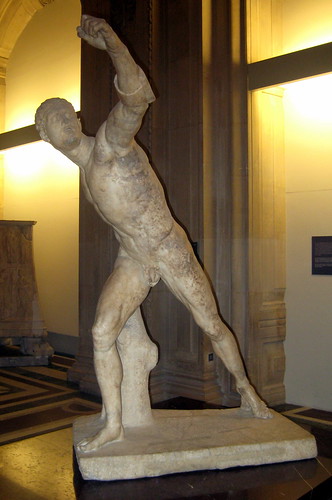

The first room contained some well-known names to those of you familiar with art history, or just with Dante's Divine Comedy. Cimabue and Giotto, two great painters of the 14th century, who, like all their contemporaries, painted only religious scenes. Whereas Cimabue's style places him squarely in the medieval school, on account of his highly impersonal representations of saints and angels outside of time and space, however well he executed them, Giotto began to innovate, and began to situate his paintings in time, at precise moments in history. Today, it seems obvious that a painting, even a still-life or a portrait, is in some sense a snapshot of a particular object at a particular time, but in the middle ages, Mary and Jesus, surrounded by angels, stare out at the spectator in a kind of calm eternity. They are objects of veneration. However, Giotto welcomes his viewers to imagine a specific moment in time. His paintings changed not only the history of art, but also the history of religion; according to Van Loon's Arts, Giotto's wonderful paintings of the life of Saint Francis of Assisi are what brought about such enormous popularity to this sect (indeed, the Franciscans are still around today, and I have a friend who is considering joining them, although he seems to be leaning closer to the Dominicans). I saw one of these paintings, and it was quite fantastic, capturing the moment in which Saint Francis received the stigmata (I also saw a very obvious imitation of it by a painter of the Sienese school, who lacked the creativity to compose his own tableau). In the same room, of a slightly later period, were two 15th-century monk-painters, Fra Angelico and Fra Filippo Lippi, who were lucky enough to be painting after Brunelleschi invented linear perspective, and also lucky enough to be patronized by the Medici. While Fra Angelico had an enormous love of bright color, Lippi played with light and shadow, and made great strides (to my eyes) in increasing the level of realism in painting, even going so far as to situate a self-portrait rather prominently in one painting. For those of you who don't know, Lippi was a great womanizer, and Cosimo de Medici often had to be patient with the monks debaucheries.


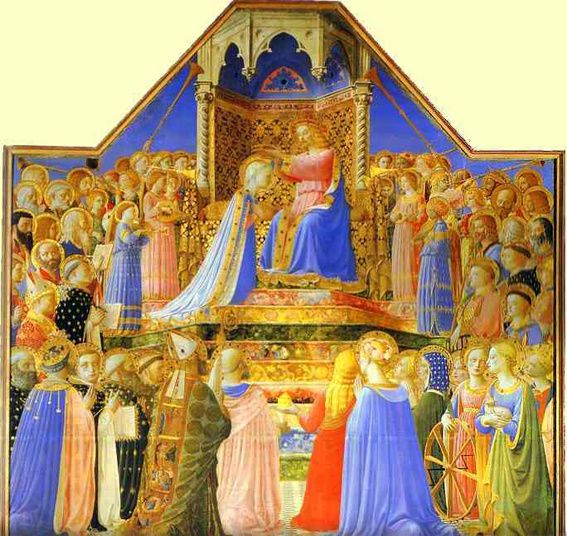

Yes, and so the Renaissance was beginning. The Louvre has several paintings by such illustrious artists as Titian, Raphael, and Leonardo da Vinci. Yes, I saw the Mona Lisa, although I wasn't paying as strict attention to it as the mob of tourists waiting in line to come within several meters of the painting. It turns out that the woman in the painting is actually a historical figure, and that the French title of the painting, "La Joconde," is actually a pun on her surname; the painting might have been intended as a wedding present, even though Francois I brought it home in his luggage after his wars in Italy. Facing the Mona Lisa is Veronese's huge, huge painting, "The Wedding of Cana," the largest painting in the Louvre; I have absolutely no idea how they even managed to transport it to its current location: they must have unrolled it, and constructed the frame inside of the gallery, and then hung the painting on a nail the size of a parking meter. The massive painting was commissioned by a Dominican monastery, who hung it in their dining hall. However, the Dominican order forbids speaking during mealtimes, so the lively painting, full of action and music (the musicians may have been modeled after musicians whom Veronese knew personally) ended up accompanying many a dour, silent meal. In the same gallery is hidden a fairly good painting entitled "Concert champetre," or "meadow concert;" the painting depicts a singer and a lute-player just about to begin playing, accompanied by two nudes. The composition is actually a clever allegory of poetry, and the inner and the meanings hidden between the lines, as represented by the two naked women. Not far from these is a colorful painting of Paradise that once hung over the throne of the doge, in Venice. The last painter not to miss in this room is a less-known Bassan, who decided to include depictions of daily life in his work, which was at the time an unusual choice. In a painting of what is ostensibly Hephaestus's forge, the artist visited a local smithy, and has meticulously portrayed the artisans at work; in another painting, Bassan took the same approach towards viticulture and wine-production.

There are a number of other interesting 16th-century paintings in the gallery. There is a series of four portraits, called the Four Seasons, by Arcimboldo, and presented to Maximilien II of the Holy Roman Empire in 1573. The painting, four portraits cleverly composed of various vegetable and floral arrangements, are actually symbolic palimpsests, simultaneously presenting the four seasons, the four humors, and the unity of an Empire that was a variegated hodgepodge of various nationalities, language-groups, and religions. There are some excellent religious paintings dating from the early Counter-Reformation, and particularly good are those painted by a fellow named Carrache, who also took the trouble to paint countryside scenes of fishing and hunting, towards the late 16th and early 17th centuries. One of the most unusual paintings of this section, however, is a large painting situated in the middle of the corridor, depicting the same scene from two different angles, one on one canvas, and another on a canvas on the opposite side. The scene is that of David about to decapitate Goliath with the latter's sword; from one side, one sees the faces of the two, and from the other, the backs; the painter's name is Danielle de Volterra.

In the Louvre's exhibit on Italian painting, between the 16th and the 17th centuries are two markers. The first is a large white urn, placed in the center in the hallway; the second is the series of works by Caravaggio (such as this one), who recreated painting. Developing (though not inventing) the method of clair-obscur, this painter completely changed the way painters depicted light, just as da Vinci had a century or so earlier. If you love the light of Vermeer, and the darkness of Rembrandt (as I do), you will know what I mean. Although I still prefer the work of the two Dutchmen to that of the Italian, it is only because the former have a special place in my heart. However, Caravaggio did more than transform style, he also made a drastic change in subject; although "humanist" is an overused and imprecise term, I believe that it characterizes his general elision of angels from his paintings. There are certainly exceptions to this (such as the painting of the Akedah), but when angels appear, they seem human, obeying the same laws of light and shadow as human subjects; likewise, even when halos appear, they are faint circles.

After Caravaggio, there are few remarkable paintings. Painters who I had not heard of, whom I will probably forget, such as Le Guerchin, Revi, Le Dominiquin, and Salvatore Rosa, dominated. This last painter has an interesting story, however. When he was young, he spent time with a group of bandits, and many of his paintings include violent themes. His most famous, "Bataille heroique," painted 1652, is intriguing, because it is anything but heroic; it is violence, pure and simple. The painting followed a series of extremely violent civil wars in France (which I have been reading about), and this painter decided to paint a battle without heroes, fought in a smoking, deserted landscape. Needless to say, Louis XIV wasn't too excited about it, and nobody paid much attention to it for a few centuries. Now, according to the Louvre curators, it is without a doubt his most famous painting.
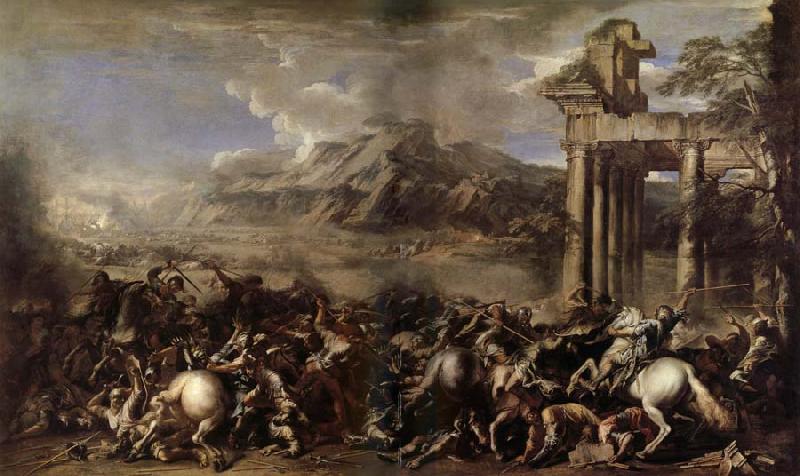
That night, I went out with some Cornellians, and didn't get back until 4 am. It was a long day!
~JD
"Aucun d'eux ne pensait qu'un roi eleve dans l'eloignement des affaires osat prendre sur lui le fardeau de gouvernement. Mazarin avait prolonge l'enfance de ce monarque autant qu'il l'avait pu" [Not one of them thought that a king raised at a distance from the affairs of state would dare to take upon himself the burden of governing; Mazarin had prolonged the childhood of this monarch as much as he could] (Voltaire, Le Siecle de Louis XIV, p. 229).
Monday, September 12, 2011
A trip to the Louvre
I spent a good six hours at the Louvre yesterday, looking at art and artifacts until I simply couldn’t bear to look at any more. All in all, though, I think that I passed through about 15% of the rooms, and probably didn’t “see” everything those rooms had to offer! Notwithstanding, I had a fantastic time, and saw some truly amazing pieces: however, not one of them was one of the items, such as da Vinci’s Mona Lisa (aka La Joconde) or the Venus de Milo, for which the Louvre is famous. The highest-profile object I saw, in fact, was the collection of crown jewels, which had almost no historical information posted -- the signs mostly just listed the number of precious stones which decorated each ornament (as with so many other institutions, it was Francois I who began the collection of “crown jewels”). So I’ve taken the trouble to name a few of the pieces which I saw which I thought were worth the trouble to find, and to which I can ascribe the highest interest-to-traffic ratio.
1) The first self-portrait: around the year 1450, Jean Foquet made a palm-sized engraving on a gold medallion of his own face. His is the first self-portrait, in all of Occidental art history, of which we know. It is well-executed, too, Fouquet having used extremely fine tools, including a needle, to scratch textured patterns on the black enamel. The birth of the self-portrait is very much associated with the Renaissance, in the spirit of the displacement of older, impersonal forms of representation: Ghiberti’s knoblike little bust appears on his famous golden doors, for instance. It is therefore surprising to find that the first self-portrait is not only found in France, and not in Italy, but appeared before the real burst of Italian influence in French art and architecture, inaugurated by Francois I. All the more reason to argue against a single monumental event, “the Renaissance,” in favor of the transitions and trends which confront the historian in nearly all lands and ages.
2) Helmet and shield of Charles IX: Created circa 1572, these gold armaments are for decoration, not for combat. The detail of the decoration of the shield is extremely fine, an example of the work of the school of Fontainebleau, and depicts the exploits of the Roman general Marius. (For those of you who don’t know, Marius was a sort of proto-Caesar, the general who professionalized the Roman army, and declared himself dictator-for-life, although he actually retired late in his career.) The cloth on the back of the shield is also very rich.
3) Napoleon’s tableware: displayed in one china closet are forty elements of one of Napoleon I’s 60-piece tableware. What is amazing about this set in particular is that the designs on the plates, each of which is unique, are based upon entries in Diderot’s Encyclopedia. There are scenes of people working, in workshops, fields, mills, smithies, and mines; there is a scene of young men swimming; there are humorous scenes depicting a schoolmaster. The set was completed by the Sevres porcelain industry, founded in 1740. Adjacent to the Encyclopedia collection is one of Napoleon I’s tea services, called the “Cabaret Egyptien,” completed 1808-1810. Each unique piece in the service depicts a person, place, or monument from General Bonaparte’s (he wasn’t yet emperor) Egyptian campaigns. There are portraits of sheiks, of beggars, of Beduins, and of a Jerusalem Jew; there are quiet oases and towering pyramids.
4) Cycladic figurines: There are galleries and galleries of fantastic Ancient Greek art, mostly pottery, which, if you have the patience to look carefully at the displays, and to listen attentively to the audio guide, will gradually walk you through the various styles, as they evolved, shifted, and went in and out of fashion, from the 3rd millennium B.C.E. to the 4th century BCE. One room, in six steps, shows the transition in sculpture, and contains a case of the feminine figurines, c. 2700-2300 BCE, and native to the Cyclades, most of which are just a few inches tall, but some of which achieved a height of several feet (the head still exists of one of these). Not only do these represent some of the earliest known art known in the western world, but there is a bit of a historical controversy swirling around these white clay manikins. Most of the figurines are in the shape of a standing naked woman with her arms crossed below her breasts, which has led some to claim that they were the work of a peaceful feminist society that was later displaced by hordes of the violent, misogynistic Hellenes, with the male-dominated mythology we all know and love. Regardless, the figurines have a mysterious and antique beauty, with their curving noses and rigid postures.
5) The scepter of Charles V: Charles had his golden scepter topped with a figurine of Charlemagne, the first Holy Roman Emperor (crowned Christmas Day, 800), to symbolically legitimize the Capetian occupancy of the throne, with deliberate links to antiquity. The scepter is extremely well-preserved, having lost only the white enamel that covered the fleur-de-lys budding beneath Charlemagne’s throne.
6) In this series of colorful Renaissance tapestries, each piece depicts hunting in one month. There is a great deal of action, and scenes of the life of the nobility, found throughout. The artists did not hesitate to include the odd scatological element: in July, right in the foreground of the piece, is a dog doing its business.
7) Jewel cabinet of Empress Josephine: elegantly ornamented with classical scenes and a butterfly motif, this large dresser later passed on to Napoleon’s second wife, after he divorced Josephine. The piece is one of the best-preserved in the Imperial style.
8) Objets d’art from Limoges: Among the piles and piles of medieval relics and sacred objects of gold and ivory found in the Louvre are several rooms filled mostly with the products of goldsmiths’ workshops in Limoges, a region in Southwest France. The Limoges artisans had a very recognizable style, using the same colors of light blue and pale green precious stones, very shallow lines, and faces of traced characters in relief.
9) Throne of Napoleon I: The blue-and-gold seat is surprisingly modest, given the kind of pomp to which Napoleon was given in his imperial garb. Moreover, just around the corner, you can see a painting of the throne, in the background of a full-length portrait of Napoleon I. Either the chair has been well-restored, or has been well-preserved, because the colors seem not to have faded at all!
10) Tapestry of Saint Martin: I found my old friend, Saint Martin, in an Icelandic hagiographic tapestry, dating from between the 14th and 16th centuries. I recognized many of the scenes: the cutting of the cloak, the healing of the sick, the raising from the dead of a hanged man, and the transportation on board a ship of Saint Martin’s remains. A very good tapestry, but mostly interesting just for old times’ sake!
Thank you, Bruno, for inviting me to your apartment! I had a wonderful time with you on Sunday evening, and look forward to seeing you and your family again soon. Maybe your daughter won’t be so afraid of me next time…
~JD
“Mille pensers dormaient, chrysalides funebres/ Fremissant doucement dans les lourdes tenebres,/ Qui degagent leur aile et prennent leur essor,/ Tentes d’azure, glaces de rose, lames d’or” [A thousand thoughts slept, funereal chrysalises, softly shaking in the heavy dusk, which lift wing and take flight, tinted with azure, iced with pink, bladed with gold]. ~Beaudelaire, "XLVIII. -- Le Flacon”
Subscribe to:
Posts (Atom)